Corkscrew Willow
$39.95
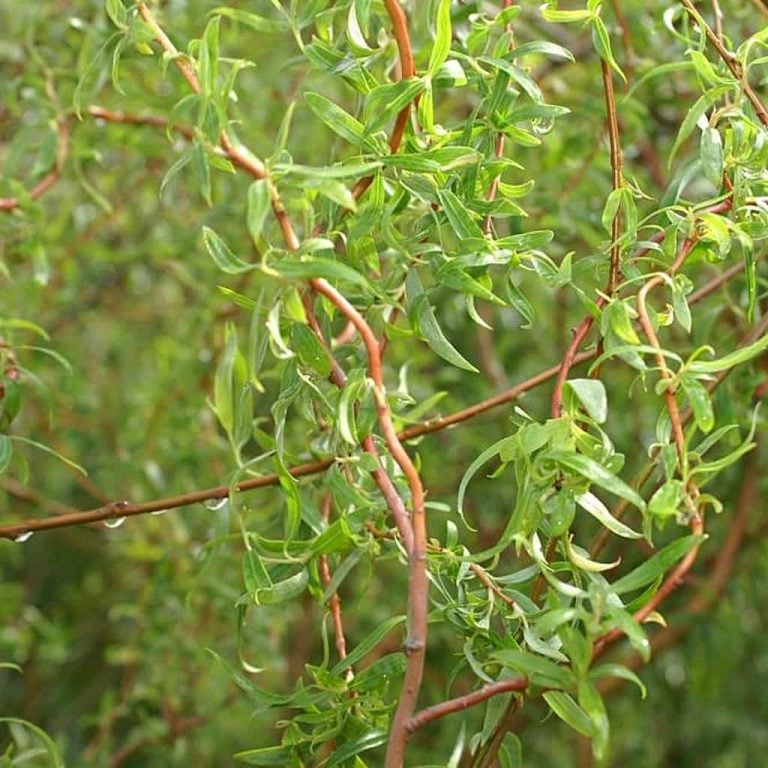
Corkscrew Willow (also known as Curly Willow; Salix matsudana ‘Tortuosa’) is an upright deciduous tree whose every branch and twig spirals in dramatic helical contortion, delivering bold sculptural form and striking winter silhouette near ponds or rain gardens. It grows in USDA hardiness zones 4-9 and AHS heat zones 3-8.
4-5′ Bare Root Tree
Propagation: Own-root
In stock
Corkscrew Willow is a selected form of Hankow willow (Salix matsudana), a species native to northeastern China and Korea named for the Japanese botanist Sadahisa Matsuda. The cultivar ‘Tortuosa’ — Latin for twisted — arose as a spontaneous growth mutation producing helical contortion throughout every branch and twig, from the main scaffold to the smallest laterals. All plants in commerce are female clones propagated vegetatively; the cultivar cannot be raised true from seed. The Arnold Arboretum in Boston received cuttings from China in 1923, named the cultivar the following year, and the tree entered wider nursery commerce during the 1930s. The taxon has accumulated several synonyms reflecting historical taxonomic debate over the parent species: Salix babylonica var. pekinensis ‘Tortuosa’ and S. babylonica f. tortuosa appear in older literature and are still used interchangeably. The contortion is most readable in winter when leaves are absent, which has made the cut branches a staple of floral design — a use distinct from the living tree’s ornamental value. It is widely marketed under the common names Dragon’s Claw Willow and Rattlesnake Willow, names that reflect the same branch character under different regional conventions.
Consistent soil moisture is the primary site requirement—not just at establishment but through the life of the tree. Sites near ponds, streams, rain gardens, or low-lying areas with seasonally wet soils suit it best. The species tolerates a noticeably wide pH range from 4.5 to 8.0, so soil chemistry rarely limits placement. Full sun produces the densest canopy and strongest growth; partial shade is tolerated but reduces vigor and can increase disease pressure by slowing tissue drying after rain events. Fast growth—commonly 6 to 8 feet per year under good moisture—means the tree fills a space quickly, but also that deadwood accumulates at a similar pace. Plan annual pruning cycles to remove crossing branches and brittle laterals before storm damage occurs. Because surface roots spread aggressively and can penetrate water lines, septic systems, and irrigation infrastructure, site this tree at least 30 feet from any buried utility or structure. The aggressive root system also makes container growing impractical.
USDA Hardiness Zone: 4-9
AHS Heat Zone: 3-8
Sun Requirements: Full Sun to Partial Shade
Soil pH: 4.5-8.0
Soil Type: Clay, loam, sand; adaptable; prefers heavy, moist soils
Soil Drainage: Moist to wet; tolerates intermittent flooding
Water Requirements: High; requires consistently moist to wet soil
Drought Tolerance: Low
Plant Spacing: 15-20 ft apart
Container Suitability: Not suitable; aggressive roots and large mature size
At maturity, Corkscrew Willow reaches 20 to 30 feet tall and 10 to 15 feet wide, forming an upright silhouette that differs from the broadly weeping form of true Weeping Willow. The narrow crown and upright scaffold limit the shade footprint, making it practical as a specimen near water features without dominating the surrounding planting. The contorted branch habit that defines this cultivar also creates structural liability: the helical wood grain is more prone to splitting under ice, snow, and wind load than straight-grained competitors. Expect to manage broken limbs after storm events. Narrow lanceolate leaves, light green above and gray-green beneath, give fine-textured summer foliage; fall color is a muted greenish-yellow with no ornamental significance. The tree’s main seasonal display comes in late winter and early spring when bare contorted branches are fully visible and pale yellow catkins open along the twisted stems. Growth rate is fast, but the trade-off is a comparatively short lifespan of 30-plus years under favorable conditions.
Mature Height: 20-30 ft tall
Mature Spread: 10-15 ft wide
Growth Habit: Upright with weeping/contorted branching; irregular, sculptural form
Growth Rate: Fast
Foliage Type: Deciduous
Food Forest Layer: Canopy
Leaf Color: Light green above, gray-green beneath; narrow lanceolate leaves
Fall Foliage Color: Greenish-yellow (undistinguished)
Thorns?: No
Attracts Wildlife: Bees, Butterflies, Moths, Birds
Life Span: typically 30+ years under good conditions
Corkscrew Willow is dioecious—male and female flowers occur on separate individual plants. Pale yellow catkins emerge in early April through mid-May in temperate climate, providing one of the earliest nectar and pollen sources available to foraging bees after winter. Both wind and insects carry pollen between plants. For ornamental planting purposes, the dioecious nature requires no management action; seed set is irrelevant to the tree’s landscape function. Male trees produce pollen-bearing catkins without any seed-cotton litter; female trees produce seed-bearing catkins that release cottony fluff in late spring. Growers who want to avoid the seed-cotton cleanup should select male-clone nursery stock when available. The early catkin bloom overlaps with early-season pollinator activity, making willows generally valuable as a keystone genus for native bees and early-season colony buildup.
Bloom Season: Very Late
Bloom Window: Early Apr - Mid May
Pollination Requirements: Dioecious; male and female flowers on separate plants; wind and insect pollinated
Pollination Mechanism: Wind and insect (bee) pollinated
Flower Color: Pale yellow (catkins); insignificant
Corkscrew Willow is an ornamental tree with no commercially significant fruit or food value. Its landscape contribution comes from three distinct seasonal features: the twisted branch architecture visible from late fall through early spring; pale yellow catkins that open in early April through mid-May, providing early nectar and pollen for foraging bees and other early pollinators; and fine-textured deciduous foliage through the growing season. Willows as a genus rank among the most important keystone plants for Lepidoptera in North America, supporting more than 300 moth and butterfly species. The catkins support early-emerging bumblebee queens and honey bee colonies building population before other food plants are in bloom. The contorted stems have practical craft value: they are harvested for floral arranging, wreath-making, and basketry. Inner bark contains salicin, a precursor compound to salicylic acid with documented traditional use, though this is not a commercial or culinary application.
Corkscrew Willow carries susceptibility across its primary disease and pest categories; integrated management planning is warranted before siting this tree. Willow Scab (Venturia saliciperda) is the most damaging fungal disease, causing rapid defoliation in humid springs; management centers on annual crown thinning for air circulation and removing infected leaf litter after leaf drop to break the overwintering inoculum cycle. Black Canker (Phyalospora miyabeana) often accompanies willow scab, causing sunken cankers on shoots; prune infected wood well below the margin and sterilize tools between cuts with 70% isopropyl alcohol. Crown Gall (Agrobacterium tumefaciens) enters through pruning wounds; prevention through clean tools and avoiding root zone damage is the only strategy. Powdery Mildew (Uncinula salicis) and Cytospora Canker (Cytospora chrysosperma) are moderate concerns; good drainage and air circulation reduce incidence. Poplar and Willow Borer (Cryptorhynchus lapathi) targets stressed trees preferentially—consistent soil moisture is the primary preventative. Aphid pressure (Pterocomma spp.) is managed with a directed water spray or beneficial insects; avoid nitrogen-heavy fertilizing that produces the succulent growth aphids prefer. Willow Leaf Beetle (Plagiodera versicolora) and Scale Insects (Chionaspis salicicola) are moderate concerns; horticultural oil applied during dormancy addresses scale crawlers organically.
Willow Scab: Susceptible
Black Canker: Susceptible
Crown Gall: Susceptible
Powdery Mildew: Moderately Susceptible
Cytospora Canker: Moderately Susceptible
Poplar and Willow Borer: Susceptible
Willow Aphids: Susceptible
Willow Leaf Beetle: Moderately Susceptible
Scale Insects: Moderately Susceptible
- Site Away from Infrastructure: Surface roots spread aggressively toward moisture; maintain at least 30 feet clearance from foundations, sewer lines, septic fields, and buried irrigation to prevent root intrusion.
- Scab and Canker Sanitation: Rake and dispose of fallen leaves each autumn — do not compost — to reduce overwintering inoculum for Willow Scab and Black Canker.
- Aphid Management Timing: Monitor new growth flushes in late spring; intervene with a directed water spray or insecticidal soap at first colony establishment before populations build to levels that cause branch tip dieback.
- Borer Prevention Through Vigor: Poplar and Willow Borer targets stressed trees preferentially; consistent soil moisture is the most effective preventative measure since drought-weakened willows attract significantly heavier borer pressure.
- Annual Storm-Prep Pruning: The contorted wood grain is structurally brittle; remove crossing and weakly attached branches each late winter to reduce breakage after ice and wind events.
We ship in late winter or early spring based on your USDA hardiness zone.
We strive to ship orders on the scheduled dates listed in the table below. However, please note that the actual shipping date may be subject to change due to factors like weather conditions and order volume.
The specific date for shipping your order will be determined according to your zipcode at the time of checkout.
Our plants are shipped bare root, packed in moist sawdust, and securely wrapped in plastic to prevent the roots from drying out. We use USPS Ground Advantage for shipping, ensuring that your plants typically arrive within 2-5 days after packaging.
In case you're unable to plant the trees immediately upon arrival, we recommend soaking them in water for a few hours and temporarily heeling them in. Ideally, they should be planted within three days of receipt for optimal health.
See our full shipping policy and map here
| Zone | Ship Date |
|---|---|
| 11 - 8b | March 1st, 2027 |
| 8a - 7b | March 8th, 2027 |
| 7a | March 15th, 2027 |
| 6b | March 22nd, 2027 |
| 6a | March 29th, 2027 |
| 5b - 5a | April 12th, 2027 |
| 4b - 4a | April 26th, 2027 |
| 3b - 1a | May 3rd, 2027 |
Our 365-Day Plant Guarantee: We ensure that our plants are delivered to you alive and healthy. If your plant does not survive its first year, you're eligible for store credit under these conditions:
- Your location falls within the appropriate USDA hardiness zone for the plant variety (refer to our hardiness zone map).
- You maintain the roots' moisture and plant within three days of delivery, following the instructions in our Planting Guide.
If you're concerned about your plant's health, please consult our guide, How to Tell if Your Tree is Dead or Dormant. Remember, our plants are shipped in a dormant state and may leaf out at different times based on their species. To check for plant vital
Related products

Shinseiki Asian Pear
Checking fit
Chinese Chestnut
Checking fitRated 5.00 out of 5
American Hazelnut
Checking fitRated 4.57 out of 5
Orient Pear
Checking fitRated 5.00 out of 5


Reviews
There are no reviews yet.