Cascade Delight Raspberry
$12.95
Cascade Delight Raspberry (Rubus idaeus) is a WSU-bred floricane red raspberry producing very large, firm, deep-red berries up to 1.5 inches with an intensely sweet traditional raspberry flavor excellent for fresh eating, freezing, and baking. It grows in USDA hardiness zones 4-8 and AHS heat zones 2-7, needs 800-1600 chill hours, and is self-fertile, fruiting reliably without a pollinator partner.
1-2′ Bare Root Plant
Propagation: Own-root
In stock
Cascade Delight was developed by Dr. Patrick P. Moore at the Washington State University Puyallup Research and Extension Center and released in 2003 under the internal designation WSU 1090 (U.S. Plant Patent PP14,522). The documented parentage is Chilliwack × WSU 994: Chilliwack is a firm-fruited floricane red raspberry released by Agriculture and Agri-Food Canada in 1987, while WSU 994 is a WSU breeding selection selected for long fruiting laterals and high drupelet count. The cross was made in 1989 with the objective of producing a machine-harvest-tolerant cultivar combining Chilliwack’s berry firmness with the yield architecture of the WSU selection. Cascade Delight is part of WSU’s long-running floricane red raspberry improvement program aimed at Pacific Northwest commercial production, though it performs across a wide range (zones 4–9). The patent expired in 2022.
Cascade Delight performs across a wide soil spectrum, including clay-loam and organic-rich soils with moderate moisture retention — an advantage over varieties more sensitive to wet feet. That said, consistently waterlogged roots will still cause problems; raised rows or beds with crowned centers improve drainage enough to avoid root rot even on borderline sites. Soil pH of 5.6 to 6.5 keeps iron and manganese available for cane development; pH drift above 6.5 triggers yellowing in new growth. The variety wants at least 6 hours of direct sun daily, with full sun pushing higher berry count per floricane. Consistent irrigation of roughly 1 inch per week becomes critical from fruit set through harvest — water stress mid-season reduces berry size noticeably. Chill requirements of 800 to 1,600 hours place it in typical mid-belt and northern territory, unsuitable for low-chill regions but well-matched to zones 4 through 7 where winters routinely satisfy the upper range.
USDA Hardiness Zone: 4-8
AHS Heat Zone: 2-7
Chill Hours: 800-1600
Sun Requirements: Full Sun to Partial Shade (6+ hours direct sun preferred)
Soil pH: 5.6-6.5
Soil Type: Loam, sandy loam; tolerates clay and high organic matter soils
Soil Drainage: Moist but well-drained; notable tolerance of wet/heavy soils
Water Requirements: Medium; consistent moisture during fruiting, approximately 1 inch per week
Plant Spacing: 3-4 ft apart in rows; rows 6-10 ft apart
How to Prune: Remove floricanes (fruited 2nd-year canes) to ground after harvest; tip primocanes at 4-5 feet in summer; thin to 4-5 canes per foot of row in late winter
Canes grow upright and erect to 4–6 feet tall on a 3–4 foot footprint, requiring a two-wire trellis system or stake support to keep floricanes from arching under fruit weight at peak production. Growth rate is fast; primocanes emerging in spring reach full height by midsummer and need tip-pinching at 4–5 feet to encourage lateral branching, which increases the fruiting surface the following season. The nearly thornless character — sparse, small prickles on the canes rather than dense spines — makes harvest and pruning noticeably more comfortable than traditional thorny varieties. Individual canes are biennial: primocanes grow vegetatively in year one, become fruiting floricanes in year two, then die and are removed to the crown after harvest. The crown itself is perennial and productive for 10–15 years. Fibrous, shallow, suckering roots spread from the crown and can colonize a 1–2 foot radius without control.
Mature Height: 4-6 ft tall
Mature Spread: 3-4 ft wide
Growth Habit: Upright, erect canes; requires trellis or wire support
Growth Rate: Fast
Foliage Type: Deciduous
Food Forest Layer: Shrub
Thorns?: Nearly thornless (sparse, small prickles on canes)
Attracts Wildlife: Bees, butterflies, birds, small mammals
Life Span: productive crown 10-15 years; individual canes biennial
Cascade Delight is self-fertile, relying on its own pollen for fruit set. White flowers open from late May through mid-June, attracting bees and other pollinators; insect activity measurably improves fruit count and uniformity even on self-fertile cultivars by ensuring thorough pollen transfer between flowers. No cross-pollinator is required for a productive planting. Growers who want to extend their summer raspberry season rather than increase fruit set on existing canes should plant a second floricane variety — Cascade Harvest or Meeker, for example — timed to overlap bloom windows and stagger the harvest by one to three weeks. Early-primocane varieties like Autumn Bliss or Caroline bloom at a different period and would not extend the summer window, though they can provide a fall crop from the same planting space.
Bloom Season: Early
Bloom Window: Late May - Mid Jun
Pollination Requirements: Self-fertile
Pollination Mechanism: Insect-pollinated (bees primary); self-fertile
Flower Color: White
Ploidy: Diploid (2n=14)
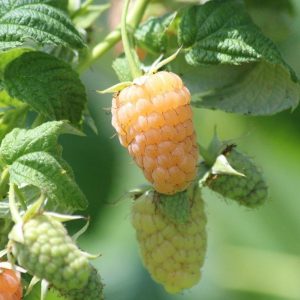
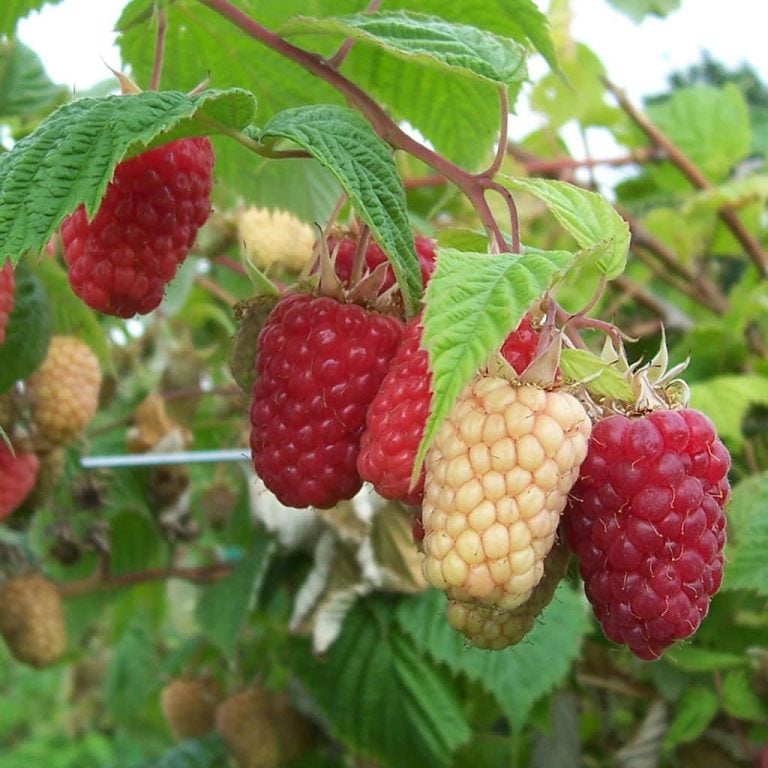
Berries average 5 grams with early-season fruit frequently reaching 8.4 grams — one of the largest berry sizes consistently documented in Pacific Northwest trial data. Diameter runs 1.0 to 1.5 inches. Flavor is intensely sweet with classic red raspberry aromatics; acidity is moderate, making the berry accessible for fresh eating while still providing enough structure for cooked preparations. Flesh firmness is the trait that distinguishes Cascade Delight commercially: berries hold their shape through transport and refrigeration better than softer cultivars like Meeker, extending the fresh market window by one to three days. The glossy deep-red skin is cosmetically appealing. Storage life is excellent relative to raspberry standards — refrigerate at 33–35°F and use within five to seven days for fresh eating, or freeze within 24 hours of harvest for long-term preserves. Culinary applications include fresh eating, freezing, jams, pies, sauces, and baked goods.
Ripening Season: Early
Harvest Window: Mid Jul - Mid Aug
Fruit Size: 1-1.5 inch (large; ~5 g average, up to 8.4 g early-season)
Fruit Weight: 5-8.4 g (0.18-0.30 oz)
Flavor: Intensely sweet; traditional red raspberry flavor
Fruit Color: Deep red
Fruit Texture: Firm
Fruit Skin: Glossy
Bearing Habit: Floricane (summer-bearing); fruits on second-year canes in one sustained summer crop
Years to Bear: 1-2 years
Storage Life: Excellent shelf life for a raspberry; firm flesh extends fresh market window
Culinary Uses: Fresh eating, freezing, jams, preserves, pies, baking, sauces
Cascade Delight's most commercially significant disease attribute is very high resistance to Phytophthora root rot (Phytophthora fragariae var. rubi), which causes rapid crown collapse on poorly drained or clay-heavy sites. Growers on heavier soils can establish Cascade Delight with substantially lower risk, though raised-row drainage still reduces residual pressure. Anthracnose (Elsinoe veneta) resistance is moderate — canopy thinning and prompt removal of infected canes keeps lesions manageable. Gray mold (Botrytis cinerea) susceptibility is a real concern during wet harvest conditions; removing infected fruit immediately, pruning for airflow, and harvesting frequently reduces spore load. Spur blight (Didymella applanata) and cane blight (Leptosphaeria coniothyrium) show moderate susceptibility — both respond to floricane removal after harvest and disinfecting pruning tools between cuts. Spotted Wing Drosophila (Drosophila suzukii) and Large Raspberry Aphid (Amphorophora agathonica) are significant pest risks; SWD monitoring with sticky traps and kaolin clay beginning at early color change, and aphid pressure managed through reflective mulch and native parasitoid wasps, address both without synthetic inputs. Raspberry Crown Borer (Pennisetia marginata) and Japanese Beetle (Popillia japonica) show moderate susceptibility; physical removal of beetles at dawn and beneficial nematodes applied to the root zone for crown borer larvae are effective organic responses.
Gray Mold: Susceptible
Phytophthora Root Rot: Very Resistant
Spur Blight: Moderately Susceptible
Cane Blight: Moderately Susceptible
Anthracnose: Moderately Resistant
Spotted Wing Drosophila: Susceptible
Raspberry Crown Borer: Moderately Susceptible
Large Raspberry Aphid: Susceptible
Japanese Beetle: Moderately Susceptible
- Tip Primocanes in Midsummer: Pinch primocanes at 4–5 feet in July to force lateral branching; each lateral becomes a fruiting unit the following season, multiplying yield per plant.
- Harvest Frequently to Beat Botrytis: Gray mold spreads rapidly in wet summer weather; pick every two to three days at peak harvest to remove ripening fruit before mold establishes. Avoid harvesting in morning dew.
- SWD Monitoring Starts at First Color: Deploy sticky traps or apple cider vinegar traps at row ends when the first berries begin turning; SWD lays eggs in softening fruit and populations build quickly in humid summers without early intervention.
- Remove Floricanes Promptly: Cut spent canes to the crown within two weeks of harvest; leaving them standing through fall creates overwintering habitat for cane blight and spur blight pathogens and increases infection pressure the following spring.
We ship in late winter or early spring based on your USDA hardiness zone.
We strive to ship orders on the scheduled dates listed in the table below. However, please note that the actual shipping date may be subject to change due to factors like weather conditions and order volume.
The specific date for shipping your order will be determined according to your zipcode at the time of checkout.
Our plants are shipped bare root, packed in moist sawdust, and securely wrapped in plastic to prevent the roots from drying out. We use USPS Ground Advantage for shipping, ensuring that your plants typically arrive within 2-5 days after packaging.
In case you're unable to plant the trees immediately upon arrival, we recommend soaking them in water for a few hours and temporarily heeling them in. Ideally, they should be planted within three days of receipt for optimal health.
See our full shipping policy and map here
| Zone | Ship Date |
|---|---|
| 11 - 8b | March 1st, 2027 |
| 8a - 7b | March 8th, 2027 |
| 7a | March 15th, 2027 |
| 6b | March 22nd, 2027 |
| 6a | March 29th, 2027 |
| 5b - 5a | April 12th, 2027 |
| 4b - 4a | April 26th, 2027 |
| 3b - 1a | May 3rd, 2027 |
Our 365-Day Plant Guarantee: We ensure that our plants are delivered to you alive and healthy. If your plant does not survive its first year, you're eligible for store credit under these conditions:
- Your location falls within the appropriate USDA hardiness zone for the plant variety (refer to our hardiness zone map).
- You maintain the roots' moisture and plant within three days of delivery, following the instructions in our Planting Guide.
If you're concerned about your plant's health, please consult our guide, How to Tell if Your Tree is Dead or Dormant. Remember, our plants are shipped in a dormant state and may leaf out at different times based on their species. To check for plant vital
1 review for Cascade Delight Raspberry
Related products

Anne Raspberry
Checking fitRated 4.88 out of 5
Nova Raspberry
Checking fit
Boysenberry
Checking fit
Cumberland Black Raspberry
Checking fitRated 5.00 out of 5


Karen (verified owner) –
Very excited for our plants to mature and fruit.