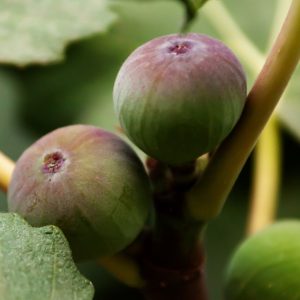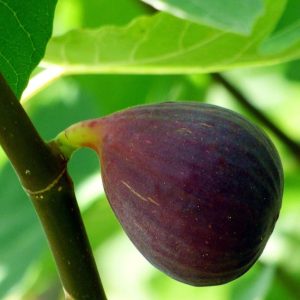
Black Mission Fig
$29.95
Black Mission Fig (also known as Franciscan Fig; Ficus carica) is a Spanish-heritage fig carried to California by missionaries, bearing small dark-purple fruit with dense, jammy dark-pink flesh rich with notes of berry, melon, strawberry, and caramel. It grows in USDA hardiness zones 7-10 and AHS heat zones 6-11, and is self-fertile, fruiting reliably without a pollinator partner.
2-3′ Bare Root Tree
Propagation: Own-root
In stock
Black Mission traces its origins to Spain, where it circulated under the name Franciscana, and was carried to Baja California by Spanish missionaries around 1520. Franciscan padres brought cuttings north into Alta California in 1768, planting them first at Mission San Diego de Alcala with the founding mission chain, then at each mission northward. By the time California’s commercial fig industry organized in the late nineteenth century, Black Mission had already accumulated more than a century of continuous cultivation along the Pacific Coast, and it became the dominant commercial standard in the San Joaquin Valley through the early twentieth century. No breeding pedigree exists: Black Mission is a centuries-old Mediterranean selection preserved through vegetative propagation, not a product of modern plant breeding. Its long California tenure has created genuine local ecotypes through decades of clonal drift, but the variety identity traces back to Iberian stock. It is unpatented and freely propagated.
Black Mission wants a Zones 7–10 climate and reaches full productivity where summers are long and warm — heat drives the sugar concentration that gives the fruit its depth. Chill hours are low, just 50–150, so it breaks dormancy early in spring; that early break is an advantage in long-season gardens but a liability in areas prone to late frosts, which can damage emerging growth.
Plant in full sun — at least 8 hours — because shade directly reduces both fruit set and flavor. The preferred soil pH sits at 6–6.5; outside that window, nutrient uptake suffers, particularly iron and manganese. Figs tolerate drought once established, but steady moisture during fruit development, mid-summer through harvest, prevents premature fruit drop and supports the 1–2 inch fruit size Black Mission is known for. Space plants 10–20 ft apart to give mature trees room to spread to their 16-ft canopy width without crowding. In marginal zones, planting against a south-facing masonry wall captures reflected heat and provides some frost protection through the wall's thermal mass.
USDA Hardiness Zone: 7-10
AHS Heat Zone: 6-11
Chill Hours: 100-300
Sun Requirements: Full Sun (8+ hours daily for best fruiting)
Soil pH: 6.0-7.5
Soil Type: Well-drained loam with organic matter; tolerates sandy and rocky soils if nematode-free
Soil Drainage: Well-drained
Water Requirements: Medium (1-1.5 inches per week during fruit development; established trees tolerate brief drought)
Drought Tolerance: High
Heat Tolerance: High
Plant Spacing: 10-20 ft apart
Container Suitability: Yes; suitable for large containers
How to Prune: Prune in late winter before new growth begins; remove dead, damaged, or crossing branches; cut back long shoots by one-third to maintain open canopy; all varieties can be pruned to three nodes per branch to control height
Black Mission grows as a deciduous multi-stemmed tree or large shrub, typically reaching 10–20 ft tall with a spread of 16 ft at maturity. Its architecture is naturally spreading and somewhat open, which improves air circulation through the canopy — a meaningful advantage given its vulnerability to fig mosaic virus, since good airflow discourages the eriophyid mite vector. Leaves are large, palmate, and deeply lobed in the classic fig form, providing dense summer shade beneath the canopy. The bark is smooth and gray, and the wood is fairly brittle compared to other fruit trees, so training to a strong central scaffold early pays dividends when branches are loaded with fruit.
Its California mission heritage reflects in the plant's preference for warm, dry conditions — the same characteristics that make it an industry standard in the San Joaquin Valley make it somewhat less forgiving in humid climates or at the cooler edges of its range in USDA zones 7 through 10. Growth rate is moderate to vigorous; established trees respond well to hard pruning in late winter, which manages size and keeps fruiting wood productive.
Mature Height: 10-20 ft tall
Mature Spread: 16 ft wide
Growth Habit: Multi-stemmed spreading tree or large shrub; rounded canopy
Growth Rate: Moderate
Foliage Type: Deciduous
Food Forest Layer: Sub-canopy
Permaculture Role: Edible fruit producer; wildlife food (birds, mammals); deciduous shade in summer; suckers freely (manage for layering propagation)
Leaf Color: Green
Fall Foliage Color: Yellow
Thorns?: No
Attracts Wildlife: Birds and small mammals (ripe fruit); bees and wasps visit ripe split fruit for sugars
Life Span: 50-100 years
Black Mission is a common-type parthenocarpic fig, which means it sets a full, seedless crop entirely on its own — no companion tree, no pollinizer, and no fig wasp is needed or helpful. The fruit develops from the internal flower structure without fertilization; that process is built into the variety's biology.
Black Mission typically bears a main crop on current-season wood from mid-August through mid-September in a temperate climate. Some sources note a light breba (first) crop on prior-season wood in early summer, though the main crop is the productive one growers plan around. Because the tree breaks dormancy on the early side — chill hours are only 50–150 — give it a sheltered planting spot if late frosts are a risk where you garden. The low chill requirement also makes it a workable choice for mild-winter gardens where other varieties may not accumulate enough dormancy to perform reliably.
Pollination Requirements: Self-fertile (parthenocarpic common-type fig) — sets fruit without pollination; no pollinizer or fig wasp needed.
Pollination Mechanism: Parthenocarpic (common-type cultivars set fruit without pollination)
Flower Color: Not applicable — tiny flowers enclosed inside the syconium, not externally visible
Ploidy: Diploid (2n=2x=26)
Fruits reach 1–2 inches in diameter, with a dark purple to black skin that develops a characteristic powdery bloom at full ripeness. Cut one open and you find dense, pink-red flesh with a creamy, jammy consistency — the texture sits between a thick jam and a fresh plum, not watery, not grainy. Flavor runs rich and honeyed with overlapping notes of berry, melon, strawberry, and caramel; sugar concentration is high enough that dried Mission figs hold their flavor intensity without added sweeteners.
Fresh eating is the most rewarding use — the thin, taut skin holds the flesh together well enough to slice cleanly or eat out of hand. Black Mission also performs well for drying (it is the commercial dried-fig standard in the US), preserves, jams, and baking applications where a dark, intensely flavored fig is the goal. Harvest timing matters: figs do not ripen off the tree, so pick when the skin darkens fully, the neck softens and bends, and a small drop of nectar appears at the eye.
Ripening Season: Late
Harvest Window: Mid Aug - Mid Sep
Fruit Size: 1-2 inch
Flavor: Rich and honeyed with notes of berry, melon, strawberry, and caramel
Fruit Color: Dark purple to black skin with powdery bloom; dark pink-red flesh
Fruit Texture: Thin, taut skin; dense, aqueous flesh with a creamy, jammy consistency
Fruit Skin: Black skin; fig produces continuously from summer to winter (California climate)
Bearing Habit: Two crops annually: breba (early summer on prior year's wood) and main crop (late summer/fall on current year's growth)
Years to Bear: 1-3 years
Storage Life: 5-7 days refrigerated; 1-2 days at room temperature
Culinary Uses: Fresh; Drying; Preserves; Baking
Black Mission's most significant vulnerability is Fig Mosaic Virus (FMV), where it rates very susceptible — widely documented as one of the cultivars most affected by this mite-vectored disease. FMV shows as yellow mosaic or mottled leaf patterns and can reduce fruit quality and yield in heavily infected trees. Start with certified virus-tested planting stock. Once established, apply dormant horticultural oil before bud break to suppress the eriophyid mite vector (Aceria ficus); remove and dispose of any branches showing severe leaf distortion — do not compost. There is no cure; management focuses on limiting spread and keeping trees vigorous.
Root-Knot Nematode (Meloidogyne spp.) rates susceptible. In nematode-prone soils, plant in raised beds or containers, amend with compost to support beneficial soil biology, and avoid replanting figs where infection previously occurred.
Fig Rust (Cerotelium fici) and Fig Leaf Blight (Pellicularia koleroga) both rate moderately susceptible — rake fallen leaves in autumn, prune for canopy airflow, and skip overhead irrigation. On the plus side, Black Mission rates very resistant to Fig Souring, Dried Fruit Beetle, and African Fig Fly, and moderately resistant to Spotted Wing Drosophila, so fruit quality holds up well once it forms.
Root-Knot Nematode: Susceptible
Fig Rust: Moderately Susceptible
Fig Leaf Blight: Moderately Susceptible
Fig Mosaic Virus: Very Susceptible
Fig Souring: Very Resistant
Dried Fruit Beetle: Very Resistant
Granulate Ambrosia Beetle: Moderately Susceptible
African Fig Fly: Very Resistant
Spotted Wing Drosophila: Moderately Resistant
- Source Virus-Tested Stock: Black Mission is highly susceptible to Fig Mosaic Virus — buy only from nurseries that propagate from tested, clean mother plants to avoid inheriting the problem at planting.
- Apply Dormant Oil Before Bud Break: A horticultural oil spray in late winter targets the eriophyid mite that vectors FMV, cutting transmission pressure before the season starts.
- Raised Beds for Nematode-Prone Soils: Root-Knot Nematode susceptibility makes sandy or previously infested soils a real risk — raising the bed isolates roots and lets you control soil biology.
- Warm Microsite at the Cold Edge: A south-facing wall with thermal mass and reflected heat can make the difference between a productive tree and a winter-killed one at the cold limit of its range.
- Prune for Airflow: Open canopy structure slows mite buildup and reduces rust and blight pressure simultaneously — one cut with three benefits.
We ship in late winter or early spring based on your USDA hardiness zone.
We strive to ship orders on the scheduled dates listed in the table below. However, please note that the actual shipping date may be subject to change due to factors like weather conditions and order volume.
The specific date for shipping your order will be determined according to your zipcode at the time of checkout.
Our plants are shipped bare root, packed in moist sawdust, and securely wrapped in plastic to prevent the roots from drying out. We use USPS Ground Advantage for shipping, ensuring that your plants typically arrive within 2-5 days after packaging.
In case you're unable to plant the trees immediately upon arrival, we recommend soaking them in water for a few hours and temporarily heeling them in. Ideally, they should be planted within three days of receipt for optimal health.
See our full shipping policy and map here
| Zone | Ship Date |
|---|---|
| 11 - 8b | March 1st, 2027 |
| 8a - 7b | March 8th, 2027 |
| 7a | March 15th, 2027 |
| 6b | March 22nd, 2027 |
| 6a | March 29th, 2027 |
| 5b - 5a | April 12th, 2027 |
| 4b - 4a | April 26th, 2027 |
| 3b - 1a | May 3rd, 2027 |
Our 365-Day Plant Guarantee: We ensure that our plants are delivered to you alive and healthy. If your plant does not survive its first year, you're eligible for store credit under these conditions:
- Your location falls within the appropriate USDA hardiness zone for the plant variety (refer to our hardiness zone map).
- You maintain the roots' moisture and plant within three days of delivery, following the instructions in our Planting Guide.
If you're concerned about your plant's health, please consult our guide, How to Tell if Your Tree is Dead or Dormant. Remember, our plants are shipped in a dormant state and may leaf out at different times based on their species. To check for plant vital
Related products

Olympian Fig
Checking fit
Loring Peach
Checking fitRated 4.50 out of 5- SOLD OUT

Texas Everbearing Fig
Checking fit 
Common Apple
Checking fit


Reviews
There are no reviews yet.