Water Oak
$11.95
Water Oak (also known as Possum Oak; Quercus nigra) is a semi-evergreen native oak with uniquely variable leaf shapes on a single tree, growing 50–80 feet tall and producing dense annual acorn masts that sustain deer, turkeys, squirrels, and a wide array of birds. It grows in USDA hardiness zones 6-9 and AHS heat zones 7-10.
1-2′ Bare Root Seedling Tree
Propagation: Seedling (own-root)
Can’t be shipped to: CA, OR
In stock
Water Oak is a native species of the Red Oak group, formally described by Carl Linnaeus in 1753 as Quercus nigra — the specific epithet reflecting the dark bark of mature trees. Its native range runs from New Jersey south through Florida and west to Texas and Kansas, with the core of its distribution anchored in the Coastal Plain and Mississippi Valley lowlands. No selective breeding history exists; this is a wild species propagated from seed. The tree is perhaps most recognizable by its striking leaf polymorphism: individual trees carry leaves that range from entirely unlobed and spatula-shaped to duck-bill forms with one to three apical lobes, all appearing simultaneously on the same branches. This is a genetically fixed trait of the species, not an environmental response or aberration. Water Oak has been documented hybridizing naturally with Southern Red Oak, Willow Oak, Shumard Oak, and several other species across its range — a promiscuity typical of the Red Oak group. Its tolerance of compacted, waterlogged, and poorly drained soils made it a go-to street and park tree throughout the Deep South for over a century.
Water Oak establishes quickly relative to most oaks — expect 2 to 3 feet of height gain per year under good conditions — and reaches 50 to 80 feet tall with a rounded to broadly spreading canopy. It performs best in USDA zones 6 through 9 and adapts to a wide range of site conditions: seasonally flooded bottomlands, heavy clay soils, and compacted urban parkways that defeat less adaptable species. Full sun produces the densest crown and the heaviest acorn crops; it tolerates partial shade in woodland settings but thins out over time without adequate light. Soil pH around 6.0 is ideal, though the tree handles mild alkalinity in urban plantings. Water Oak is semi-evergreen in zones 8 and 9, holding a portion of its foliage through mild winters before dropping it as new leaves emerge in spring. Salt aerosol tolerance is low, so avoid sites with direct coastal spray or heavy road-salt exposure. Wind tolerance is also limited — ice storms and high winds can cause branch breakage, which is worth considering when siting trees near structures.
USDA Hardiness Zone: 6-9
AHS Heat Zone: 7-10
Sun Requirements: Full Sun; adaptable to Partial Shade
Soil pH: 6.0
Soil Type: Clay, loam/silt, sand; adaptable
Soil Drainage: Moist to wet; tolerates occasionally dry or wet; well-drained sites acceptable
Water Requirements: Medium to Wet; prefers rich moist soils
Drought Tolerance: Moderate (once established)
Heat Tolerance: High
Plant Spacing: 40-60 ft apart
Container Suitability: No
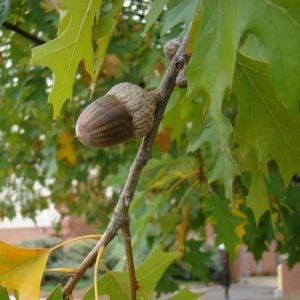
Mature Water Oaks typically stand 50 to 80 feet tall with a spread of roughly 26 feet, forming a rounded to somewhat irregular canopy that casts dense summer shade. The bark is dark gray-brown, becoming deeply furrowed on older trunks. Leaves are the most distinctive feature of this species: variable in shape even on the same branch, ranging from a narrow spatula with a slightly widened tip to a classic three-lobed duck-bill form to nearly unlobed and elliptic. All leaf forms share the Red Oak group's characteristic bristle-tipped lobes. In zones 8 and 9, the tree behaves as semi-evergreen, shedding leaves gradually in late winter rather than all at once in autumn. Growth rate is fast for an oak, making it one of the quicker-canopying natives available for large-scale restoration or landscape shade work. The root system tolerates compaction and seasonal inundation — two stresses that limit most alternative canopy trees in low-lying Southern sites.
Mature Height: 50-80 ft tall
Mature Spread: 26 ft wide
Growth Habit: Upright-spreading, rounded crown; conical when young
Growth Rate: Fast
Foliage Type: Semi-evergreen (Zones 8–9); deciduous in colder parts of range
Food Forest Layer: Canopy
Permaculture Role: Mast tree, wildlife habitat, soil builder, wind/erosion control
Leaf Color: Dark green (upper surface), paler green beneath
Fall Foliage Color: Yellow, red, or bronze
Thorns?: No
Attracts Wildlife: Yes — acorn mast for deer, turkey, squirrels, and many birds; host to hundreds of butterfly/moth larvae
Life Span: 30-50 years
Water Oak is monoecious and wind-pollinated: each tree produces both male and female flowers, so no companion tree is required for acorn production. Male flowers appear as drooping yellow catkins in April across much of the range, releasing pollen before or as the new leaves emerge. Female flowers are tiny, short-stalked spikes on the same tree. Because pollination is handled entirely by wind, bloom overlap with other oaks in the neighborhood will not significantly affect acorn set — the limiting factor is weather during the brief bloom window (cold snaps and heavy rain can reduce catkin viability). As a Red Oak group member, Water Oak acorns take two full growing seasons to mature after fertilization: catkins open in spring of year one, acorns reach full size and drop in fall of year two. This biennial rhythm means the tree is carrying two year-classes of developing acorns simultaneously through most of the growing season.
Bloom Season: Early
Bloom Window: Mid Apr
Pollination Requirements: Wind-pollinated; monoecious (male and female catkins on same tree); cross-pollination preferred but not required
Pollination Mechanism: Wind-pollinated (monoecious)
Flower Color: Yellow-green (inconspicuous catkins)
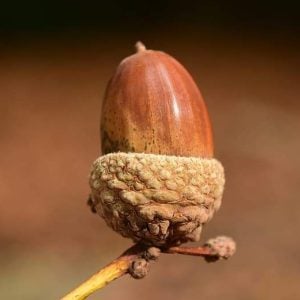
Water Oak acorns are small — roughly half an inch in diameter — nearly round, and dark brown to nearly black at maturity. They ripen and drop from September through November, representing the tree's peak wildlife contribution each autumn. Raw acorns are high in tannins (gallotannins, quercitrin, and quercitin), which makes them bitter and unpalatable without processing; however, repeated cold-water leaching over several days removes most of the bitterness and leaves a starchy, mildly nutty flour that has a long history of use as a food source. For most growers, the primary value of Water Oak acorns is ecological: they are consumed eagerly by white-tailed deer, wild turkey, wood ducks, mallards, squirrels, and a wide range of other songbirds and mammals. The small acorn size makes them especially accessible to smaller wildlife species that cannot handle the larger mast of White or Bur Oak. Mast production is biennial and heavy, with good crops in most years.
Ripening Season: Very Late
Harvest Window: Mid Sep - Mid Nov
Fruit Size: 0.5 inch
Flavor: Bitter (high tannin — gallotannins, quercitrin, quercitin); edible after leaching
Fruit Color: Brown to nearly black
Bearing Habit: Biennial mast — acorns take 2 years to mature (Red Oak group); produced abundantly most years
Years to Bear: 15-20 years (first acorn crop)
Culinary Uses: Acorn flour (after tannin leaching), acorn meal for bread and porridge, wildlife forage
Water Oak's membership in the Red Oak group makes Oak Wilt (Bretziella fagacearum) the single most important disease risk — this species is highly susceptible and the disease can kill an infected tree within weeks. The primary infection pathway is fresh pruning wounds visited by nitidulid sap beetles carrying fungal spores. Never prune Water Oak from April through July; confine all pruning to the dormant season when beetle activity and spore production are lowest. Bacterial Leaf Scorch (Xylella fastidiosa) causes marginal leaf browning that advances inward during summer heat and is spread by leafhoppers; affected trees decline slowly over years. Armillaria Root Rot (Armillaria mellea) attacks stressed root systems, particularly on trees in prolonged standing water or compacted soils. The broader Oak Decline complex — involving Armillaria, Two-Lined Chestnut Borer (Agrilus bilineatus), drought, and defoliation — can accelerate decline in weakened specimens. Anthracnose (Apiognomonia quercina) causes cosmetic leaf spotting in wet springs but rarely harms otherwise healthy trees. Among insect pests, Spongy Moth (Lymantria dispar) defoliation can stress trees in outbreak years; Oak Lecanium Scale (Parthenolecanium quercifex) and Forest Tent Caterpillar (Malacosoma disstria) are occasional concerns on urban specimens. Maintaining site drainage and avoiding unnecessary wounding remain the most effective preventive measures.
Oak Wilt: Susceptible
Bacterial Leaf Scorch: Susceptible
Armillaria Root Rot: Moderately Susceptible
Oak Decline: Moderately Susceptible
Anthracnose: Moderately Susceptible
Two-Lined Chestnut Borer: Moderately Susceptible
Spongy Moth: Susceptible
Oak Lecanium Scale: Moderately Resistant
Forest Tent Caterpillar: Moderately Susceptible
- Prune Only in Dormancy: Water Oak is a Red Oak group tree — Oak Wilt infection through fresh wounds is a genuine risk from April through July when sap beetles are active. Save all pruning for December through February.
- Variable Leaves are Normal: Leaves on the same branch can look completely different — duck-bill lobed, spatula-shaped, or nearly entire. This is species-typical, not a nutrient deficiency or disease sign.
- Site for Drainage Tolerance: Water Oak handles seasonal flooding well, but persistent waterlogging increases root rot pressure. A site that drains within 48 hours after heavy rain is ideal.
- Maximize Mast in Full Sun: Full-sun siting produces the densest canopy and the most reliable annual acorn crops for wildlife.
- Watch for Spongy Moth Pressure: During outbreak years, scout for egg masses in winter and treat with Bt or spinosad at early larval emergence to prevent repeated defoliation.
We ship in late winter or early spring based on your USDA hardiness zone.
We strive to ship orders on the scheduled dates listed in the table below. However, please note that the actual shipping date may be subject to change due to factors like weather conditions and order volume.
The specific date for shipping your order will be determined according to your zipcode at the time of checkout.
Our plants are shipped bare root, packed in moist sawdust, and securely wrapped in plastic to prevent the roots from drying out. We use USPS Ground Advantage for shipping, ensuring that your plants typically arrive within 2-5 days after packaging.
In case you're unable to plant the trees immediately upon arrival, we recommend soaking them in water for a few hours and temporarily heeling them in. Ideally, they should be planted within three days of receipt for optimal health.
See our full shipping policy and map here
| Zone | Ship Date |
|---|---|
| 11 - 8b | March 1st, 2027 |
| 8a - 7b | March 8th, 2027 |
| 7a | March 15th, 2027 |
| 6b | March 22nd, 2027 |
| 6a | March 29th, 2027 |
| 5b - 5a | April 12th, 2027 |
| 4b - 4a | April 26th, 2027 |
| 3b - 1a | May 3rd, 2027 |
Our 365-Day Plant Guarantee: We ensure that our plants are delivered to you alive and healthy. If your plant does not survive its first year, you're eligible for store credit under these conditions:
- Your location falls within the appropriate USDA hardiness zone for the plant variety (refer to our hardiness zone map).
- You maintain the roots' moisture and plant within three days of delivery, following the instructions in our Planting Guide.
If you're concerned about your plant's health, please consult our guide, How to Tell if Your Tree is Dead or Dormant. Remember, our plants are shipped in a dormant state and may leaf out at different times based on their species. To check for plant vital
Related products

Pecan
Checking fitRated 4.33 out of 5
Swamp Chestnut Oak
Checking fitRated 5.00 out of 5
Hackberry
Checking fitRated 4.83 out of 5
Nuttall Oak
Checking fit


Reviews
There are no reviews yet.