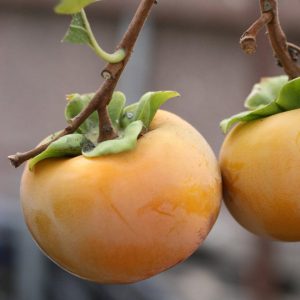
Nikitas Gift Persimmon
$59.95
Nikitas Gift Persimmon (also known as Nikitskaya Bordovaya; Diospyros virginiana x kaki) is a cold-hardy American-Asian hybrid persimmon from Crimean breeding, bearing 2.5-inch deep red-orange fruit with honey-sweet, tropical, mango-like flesh and vivid orange-red fall foliage. It grows in USDA hardiness zones 5-9 and AHS heat zones 3-9, needs 200-400 chill hours, and is self-fertile, fruiting reliably without a pollinator partner.
4-5′ Bare Root Grafted Tree
Rootstock: Diospyros virginiana
Grafted onto American persimmon seedling roots — full natural size, very cold hardy, drought tolerant once established. Expect occasional root suckers.
• Support: Freestanding; the deep taproot gives excellent anchorage.
Can’t be shipped to: CA
In stock
Nikita’s Gift is an interspecific hybrid of American persimmon (Diospyros virginiana) and Asian persimmon (Diospyros kaki), developed at the Nikitsky Botanical Garden in Yalta, Crimea (then Soviet Union) during mid-twentieth-century breeding aimed at extending persimmon culture into cooler continental climates. The garden, established in 1812 on the Black Sea coast, conducted persimmon research from as early as 1901 and is the source institution for several cold-hardy hybrid persimmon cultivars introduced to North American specialty horticulture in the late twentieth century. The precise pollen-parent kaki cultivar and the specific breeder responsible for this selection are not consistently documented in available literature, so those details should be treated as uncertain. The cultivar is also sold under the name Nikitskaya Bordovaya, a Russian phrase meaning roughly “Nikita’s Bordeaux-colored,” referencing the deep red-orange skin at full ripeness. It reached North American specialty nurseries in the 1990s and 2000s, valued for pushing Zone 5 cold hardiness while delivering fruit quality closer to kaki than to the smaller-fruited American parent.
A loam or sandy clay loam with a pH between 6.0 and 7.0 gives this hybrid its best footing. Slight acidity keeps micronutrient uptake efficient without triggering the chlorosis that more alkaline soils can cause in Diospyros species. Drainage matters more than irrigation frequency: persimmon roots are more sensitive to waterlogging than to brief summer drought, so avoid low spots or clay pans that hold water after rain. Once the taproot system is established — typically by year two or three — irrigation needs drop substantially, and the tree handles moderate dry spells without intervention. During fruit set in early summer, steady soil moisture (roughly an inch per week) limits premature fruit drop. Full sun of at least six to eight hours drives both fruit sugar development and the vivid fall foliage color this variety is also known for. Grafted trees typically reach first meaningful harvest in three to five years. Space plants eight to twelve feet apart to allow adequate airflow, which reduces foliar disease pressure in humid climates.
USDA Hardiness Zone: 5-9
AHS Heat Zone: 3-9
Chill Hours: 200-400
Sun Requirements: Full Sun (6-8 hours)
Soil pH: 6.0-7.0
Soil Type: Loam, sandy clay loam, Well-drained
Soil Drainage: Well-drained; intolerant of prolonged wet conditions
Water Requirements: Medium; approximately 1 inch per week during growing season; drought tolerant once established
Drought Tolerance: Moderate to High — established trees are fairly drought tolerant
Plant Spacing: 8-12 ft apart
Container Suitability: Not recommended — grows too large for containers
How to Prune: Prune only when limbs cross or to control size; central leader form; prune in late winter while dormant
Nikitas Gift grows with an upright-spreading habit anchored by a central leader, reaching twelve to fifteen feet tall and eight to twelve feet wide at maturity. The form is naturally tidy enough that structural pruning is minimal — remove crossing or rubbing limbs in late winter while the tree is dormant, and tip back any scaffold branches competing with the leader. The taproot system makes the tree difficult to transplant once established but contributes to its drought resilience and long life span, which can exceed a century under good conditions. Large, glossy dark green leaves through summer give way to vivid orange-to-red fall foliage that makes this a legitimate specimen tree even in landscapes where fruit production is secondary. The moderate growth rate — not as slow as some persimmons, not as vigorous as a young peach — means the canopy fills in at a manageable pace. No thorns. Deer may browse fruit heavily, but established trees resist significant foliage damage.
Mature Height: 12-15 ft tall
Mature Spread: 8-12 ft wide
Growth Habit: Upright spreading; central leader; deciduous
Growth Rate: Moderate
Foliage Type: Deciduous
Food Forest Layer: Canopy, Sub-canopy
Leaf Color: Dark green (summer)
Fall Foliage Color: Vivid orange to orange-red
Thorns?: No
Attracts Wildlife: Birds, deer, raccoons, foxes, opossums, squirrels
Life Span: up to 100 years
Nikitas Gift is self-fertile: a single tree will set and ripen fruit without a pollinator. Flowers open in late May through June, cream to pale yellow and small, pollinated primarily by bees with some wind transfer contributing. Fruit set and total yield typically increase when a second persimmon — either another hybrid selection or a male American persimmon — is planted within bee foraging range (roughly fifty to one hundred feet). Astringency at harvest depends partly on seeded versus seedless development: cross-pollinated fruit tends to set more seeds, and seeded fruit often softens and loses astringency more predictably than parthenocarpic (seedless) fruit. Growers in zones 5 and 6 should note that late frosts following early warm spells can damage open flowers; planting on a north-facing slope or near a building's north side delays bloom slightly and reduces frost interception risk.
Bloom Season: Very Late
Bloom Window: Late May - Mid Jun
Pollination Requirements: Self-fertile; single tree will produce fruit; cross-pollination with a male persimmon increases yield
Pollination Mechanism: Insect-pollinated (bees); wind pollination also possible
Flower Color: Cream to pale yellow
Fruit runs about 2.5 inches in diameter — larger than most American persimmons but somewhat smaller than premium kaki cultivars — with deep red-orange skin and soft, custardy flesh at full ripeness. Flavor registers as intensely sweet with honey and tropical notes described by some tasters as mango-adjacent; no meaningful astringency remains once the fruit has fully softened. This is an astringent-type persimmon, meaning it must reach complete softness before eating; fruit picked while still firm contains enough soluble tannins to be unpleasant. Yield is heavy once the tree matures, with fifty or more pounds annually from a single tree being common in favorable sites. Refrigerated fruit holds one to three months; the fruit also freezes well, and freezing actually accelerates tannin polymerization, which speeds the de-astringency process. Culinary applications include fresh eating, drying into hoshigaki-style rounds, baking into puddings or quick breads, and blending into smoothies or sauces. Persimmon leaves are used for tea preparations in East Asian culinary traditions.
Ripening Season: Mid
Harvest Window: Mid Oct - Mid Nov
Fruit Size: 2.5 inch
Flavor: Sweet, honey-like; similar to Asian persimmon; tropical, almost mango-like; no astringency when fully ripe
Fruit Color: Deep red-orange
Fruit Texture: Soft when ripe; must soften completely before eating (astringent type)
Bearing Habit: Annual bearer; sets fruit on current season's growth
Years to Bear: 3-5 years after planting (grafted tree)
Yield: 50+ per tree annually when mature
Storage Life: 1-3 months refrigerated; can be frozen
Culinary Uses: Fresh eating (when fully ripe and soft); drying; baking; jams; puddings; smoothies
Nikitas Gift carries moderate resistance to Persimmon Leaf Spot (Pseudocercospora diospyricola) and Persimmon Anthracnose (Colletotrichum horii), meaning typical seasons in humid climates rarely produce economically damaging outbreaks. Good airflow — achieved through the eight-to-twelve-foot spacing recommended at planting — and prompt removal of fallen leaf litter in autumn reduce inoculum load for both diseases heading into the next season. Persimmon Wilt (Cephalosporium diospyri) and Crown Gall (Agrobacterium tumefaciens) are moderate concerns. Wilt is soilborne and has no cure once established; the most effective strategy is to plant on sites with no prior wilt history and avoid wounding roots during cultivation. Crown Gall risk is managed by sourcing certified disease-free nursery stock and avoiding soil injuries at planting — galls enter through wounds. On the pest side, Persimmon Psyllid (Trioza diospyri), Scale Insects (Parthenolecanium corni / Hemiberlesia rapax), Persimmon Borer (Sannina uroceriformis), and Brown Marmorated Stink Bug (Halyomorpha halys) all rate as moderately susceptible. Psyllid and scale populations respond well to dormant-season horticultural oil applications before bud break. Persimmon Borer targets the trunk base; wrapping the lower trunk with hardware cloth and inspecting for frass in late summer catches infestations early. BMSB damage peaks at harvest; exclusion netting over individual clusters or kaolin clay applications from mid-summer onward provide OMRI-compliant protection.
Cercospora Leaf Spot: Moderately Resistant
Persimmon Wilt: Moderately Susceptible
Botryosphaeria Canker and Dieback: Moderately Susceptible
Anthracnose: Moderately Resistant
Powdery Mildew: Moderately Resistant
Persimmon Borer: Moderately Susceptible
Persimmon Psyllid: Moderately Susceptible
White Peach Scale: Moderately Susceptible
- Wait for true softness before harvest: Nikitas Gift is astringent-type — pick fruit when it gives like a ripe plum, not when it looks orange. Premature harvest produces harsh, tannic results.
- Protect the trunk base from borers: Install hardware cloth cylinders around the lower twelve inches of trunk before the first growing season; inspect for sawdust-like frass each August and remove any larvae found.
- Apply dormant oil in late winter: A thorough horticultural oil spray before bud swell disrupts overwintering scale and psyllid populations without residues that persist into harvest.
- Never wound roots near the trunk: Persimmon Wilt and Crown Gall both enter through soil-level injuries; hand-pull weeds within the drip line rather than cultivating with tools near the root collar.
- Freeze to accelerate de-astringency: Fruit that has not fully softened on the tree can be placed in a freezer for 24 hours; cell rupture from freezing accelerates tannin binding and produces soft, sweet fruit faster than countertop ripening.
We ship in late winter or early spring based on your USDA hardiness zone.
We strive to ship orders on the scheduled dates listed in the table below. However, please note that the actual shipping date may be subject to change due to factors like weather conditions and order volume.
The specific date for shipping your order will be determined according to your zipcode at the time of checkout.
Our plants are shipped bare root, packed in moist sawdust, and securely wrapped in plastic to prevent the roots from drying out. We use USPS Ground Advantage for shipping, ensuring that your plants typically arrive within 2-5 days after packaging.
In case you're unable to plant the trees immediately upon arrival, we recommend soaking them in water for a few hours and temporarily heeling them in. Ideally, they should be planted within three days of receipt for optimal health.
See our full shipping policy and map here
| Zone | Ship Date |
|---|---|
| 11 - 8b | March 1st, 2027 |
| 8a - 7b | March 8th, 2027 |
| 7a | March 15th, 2027 |
| 6b | March 22nd, 2027 |
| 6a | March 29th, 2027 |
| 5b - 5a | April 12th, 2027 |
| 4b - 4a | April 26th, 2027 |
| 3b - 1a | May 3rd, 2027 |
Our 365-Day Plant Guarantee: We ensure that our plants are delivered to you alive and healthy. If your plant does not survive its first year, you're eligible for store credit under these conditions:
- Your location falls within the appropriate USDA hardiness zone for the plant variety (refer to our hardiness zone map).
- You maintain the roots' moisture and plant within three days of delivery, following the instructions in our Planting Guide.
If you're concerned about your plant's health, please consult our guide, How to Tell if Your Tree is Dead or Dormant. Remember, our plants are shipped in a dormant state and may leaf out at different times based on their species. To check for plant vital
Related products

Saijo Persimmon
Checking fit
Loring Peach
Checking fitRated 4.50 out of 5
Black Cherry
Checking fitRated 4.71 out of 5
Honeycrisp Apple
Rated 5.00 out of 5$49.95 Select Rootstock This product has multiple variants. The options may be chosen on the product pageChecking fit


Reviews
There are no reviews yet.