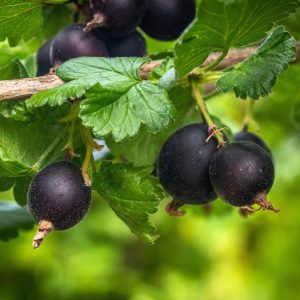
Hinnomaki Red Gooseberry
$19.95
Hinnomaki Red Gooseberry (also known as Hinnonmäki Röd; Ribes uva-crispa) is a Finnish-bred European gooseberry valued for outstanding powdery mildew resistance, bearing deep red aromatic berries with a sweet, flavorful flesh beneath a pleasantly tart skin. It grows in USDA hardiness zones 3-8 and AHS heat zones 1-6, needs 900-1100 chill hours, and is self-fertile, fruiting reliably without a pollinator partner.
1-2′ Bare Root Plant
Propagation: Own-root
Can’t be shipped to: AK, DE, HI, ME, MA, MI, NJ, NC, RI, VT, WV
In stock
Hinnomaki Red — spelled Hinnonmäki in Finnish — was developed at the Hinnonmäki research station in Finland, part of what is now MTT Agrifood Research Finland (merged into the Natural Resources Institute Finland, Luke). The station’s breeding efforts, dating to the early twentieth century, produced a Hinnonmäki series spanning red, yellow, and green selections, all bred to combine European gooseberry fruit quality with resistance to powdery mildew and the hardiness required for Nordic conditions. Hinnomaki Red belongs to Ribes uva-crispa, the European gooseberry species, and the program’s disease-resistance emphasis — powdery mildew being the primary obstacle to gooseberry culture across much of central and northern Europe — carried directly into the cultivar’s performance profile. Introduced to North American markets during the 1980s and 1990s, it quickly became a standard reference for disease-resistant European-type gooseberries available to home growers. Its consistent productivity, compact habit, and reliable annual bearing established it as a benchmark against which subsequent releases are still measured.
Hinnomaki Red adapts to USDA Hardiness Zones 3 through 8 and performs best in full sun to partial shade, appreciating afternoon shade in warmer southern portions of its range where summer heat can stress the canes. It requires roughly 1,000 chill hours, making it a natural fit for most temperate North American climates. Plant in well-drained, loamy soil with a pH between 6.0 and 7.0, amending clay soils with compost to improve drainage and organic matter. Spacing plants 3–4 feet apart allows adequate air circulation, which is important for managing foliar diseases even on this more resistant variety. A consistent moisture supply during fruit development — roughly one inch of water per week — promotes even ripening and reduces berry drop. Annual renewal pruning in late winter, removing the oldest canes and thinning crowded growth, keeps the shrub productive and open. Mulching the root zone conserves moisture and suppresses weed competition throughout the growing season.
USDA Hardiness Zone: 3-8
AHS Heat Zone: 1-6
Chill Hours: 900-1100
Sun Requirements: Full Sun to Partial Shade
Soil pH: 6.0-7.0
Soil Type: Adaptable (loam, silt, clay)
Soil Drainage: Well-drained
Water Requirements: Medium
Plant Spacing: 4-6 ft apart
Container Suitability: Yes; compact size makes it suitable for large containers
How to Prune: Prune in late winter to early spring while dormant; maintain a balance of 1-, 2-, and 3-year-old canes and remove wood older than 3 years
Hinnomaki Red grows as a compact, mounding shrub reaching 3 to 4 feet tall and equally wide at maturity, making it well-suited to garden borders, edible hedgerows, and container culture where space is limited. The canes carry the typical gooseberry thorns at leaf nodes, which deter browsing deer to some degree, though this variety is generally considered susceptible to deer pressure when other forage is scarce. Foliage is deciduous, emerging bright green in spring before the current season's berries ripen in midsummer, then dropping cleanly in autumn. Growth rate is moderate, with established plants developing a full, productive framework within two to three seasons of planting. The shrub's dense, rounded canopy makes it attractive as a functional landscape plant even outside the fruiting season. Birds and beneficial insects, including native bees that forage on the early spring flowers, are reliably attracted to the planting, adding wildlife value beyond the harvest.
Mature Height: 3-4 ft tall
Mature Spread: 3-4 ft wide
Growth Habit: Moderately vigorous
Growth Rate: Moderate
Foliage Type: Deciduous
Food Forest Layer: Shrub
Permaculture Role: Fruit shrub, wildlife forage
Leaf Color: Dark green
Fall Foliage Color: Red
Thorns?: Yes
Attracts Wildlife: Yes
Life Span: 15-20+ years
Hinnomaki Red is self-fertile and sets a full crop without a second variety nearby, making it an excellent choice for gardens with space for only a single plant. Flowers appear in early spring on short lateral spurs along the previous season's wood, attracting native bees and honeybees before many other fruiting shrubs are in bloom. Because gooseberry flowers are small and relatively inconspicuous, cross-pollination by insects proceeds naturally without any management intervention. Planting a second compatible variety — such as Captivator or Hinnomaki Yellow — nearby can modestly increase fruit set and berry size through cross-pollination, but this is optional rather than required. The mid-season ripening window, falling in early to late July, positions the harvest between the early-season strawberry flush and late-season bramble crops.
Bloom Season: Very Early
Bloom Window: Early Apr - Late Apr
Pollination Requirements: Self-fertile; no cross-pollinator required
Pollination Mechanism: Insect-pollinated
Flower Color: Greenish-yellow to white
The berries ripen to a deep wine-red — sometimes described as purple-red at full maturity — and measure 0.5 to 0.75 inch in diameter, placing them among the medium-sized gooseberries. Flavor is the characteristic gooseberry balance of tart skin and sweet, aromatic flesh, with a depth that improves as the berries fully color and soften slightly on the cane. They are firm enough to harvest cleanly and hold well during transport, which suits pick-your-own and farmers market sales. Fresh eating is enjoyable when berries reach full sweetness, but the fruit shines equally in cooked preparations: jams, jellies, chutneys, pies, and fruit wines are all traditional uses. The high pectin content of underripe berries makes them especially valuable for preserves that gel reliably without added pectin. Birds are attracted to the ripe fruit, so netting the shrub during the final weeks before harvest is advisable to protect the crop.
Ripening Season: Mid
Harvest Window: Early Jul - Late Jul
Fruit Size: 0.5-0.75 inch
Fruit Weight: 3.6-5 g per berry
Flavor: Tart skin with sweet, aromatic flesh
Fruit Color: Red (described as purple in full ripeness)
Fruit Texture: Firm to soft; juicy flesh
Fruit Skin: Crisp, translucent skin; tart
Bearing Habit: Bears on 1-3 year old wood; annual bearing
Years to Bear: 1-2 years to first fruit; full production by year 3-4
Yield: 4-5 per plant at maturity
Storage Life: 1-2 weeks refrigerated; freezes well
Culinary Uses: Fresh eating, pies, jams, jellies, preserves, wine, juice
Powdery mildew resistance is the defining characteristic of Hinnomaki Red and its primary advantage over older gooseberry varieties. Where unprotected European gooseberries routinely suffer severe mildew pressure in humid summers, Hinnomaki Red remains largely clean without fungicide applications — a meaningful practical benefit for growers committed to organic management. It carries moderate susceptibility to White Pine Blister Rust (Cronartium ribicola), the federally regulated disease transmitted through Ribes species, so growers in states with active quarantine programs should check local regulations before planting. Anthracnose leaf spot, Septoria leaf spot, and Botrytis gray mold are not well-characterized in published resistance trials for this variety; standard cultural practices — adequate plant spacing, renewal pruning to open the canopy, and avoiding overhead irrigation — provide meaningful protection against all three. Imported currantworm caterpillars can defoliate plants rapidly in late spring; inspect the undersides of leaves in May and handpick egg masses early. Gooseberry fruitworm, currant borer, and spotted wing drosophila round out the primary pest concerns; row cover during fruit set and prompt harvest of ripe berries are the most effective organic defenses.
Powdery Mildew: Resistant
White Pine Blister Rust: Moderately Susceptible
Anthracnose / Leaf Spot: Moderately Resistant
Septoria Leaf Spot: Moderately Susceptible
Botrytis Gray Mold / Cane Blight: Moderately Susceptible
Imported Currantworm: Moderately Susceptible
Gooseberry Fruitworm: Moderately Susceptible
Currant Borer: Moderately Susceptible
Spotted Wing Drosophila: Moderately Susceptible
- Harvest in stages: Pick the first flush slightly underripe for jam with natural pectin; wait another week for the sweetest fresh-eating berries.
- Renew canes annually: Remove wood older than three years in late winter to keep the plant open and fruiting on vigorous new growth.
- Net early: Install bird netting when berries first show color — robins and starlings target the crop days before peak ripeness.
We ship in late winter or early spring based on your USDA hardiness zone.
We strive to ship orders on the scheduled dates listed in the table below. However, please note that the actual shipping date may be subject to change due to factors like weather conditions and order volume.
The specific date for shipping your order will be determined according to your zipcode at the time of checkout.
Our plants are shipped bare root, packed in moist sawdust, and securely wrapped in plastic to prevent the roots from drying out. We use USPS Ground Advantage for shipping, ensuring that your plants typically arrive within 2-5 days after packaging.
In case you're unable to plant the trees immediately upon arrival, we recommend soaking them in water for a few hours and temporarily heeling them in. Ideally, they should be planted within three days of receipt for optimal health.
See our full shipping policy and map here
| Zone | Ship Date |
|---|---|
| 11 - 8b | March 1st, 2027 |
| 8a - 7b | March 8th, 2027 |
| 7a | March 15th, 2027 |
| 6b | March 22nd, 2027 |
| 6a | March 29th, 2027 |
| 5b - 5a | April 12th, 2027 |
| 4b - 4a | April 26th, 2027 |
| 3b - 1a | May 3rd, 2027 |
Our 365-Day Plant Guarantee: We ensure that our plants are delivered to you alive and healthy. If your plant does not survive its first year, you're eligible for store credit under these conditions:
- Your location falls within the appropriate USDA hardiness zone for the plant variety (refer to our hardiness zone map).
- You maintain the roots' moisture and plant within three days of delivery, following the instructions in our Planting Guide.
If you're concerned about your plant's health, please consult our guide, How to Tell if Your Tree is Dead or Dormant. Remember, our plants are shipped in a dormant state and may leaf out at different times based on their species. To check for plant vital
9 reviews for Hinnomaki Red Gooseberry
Related products

Johns Elderberry
Checking fitRated 5.00 out of 5
York Elderberry
Checking fitRated 5.00 out of 5- SOLD OUT

Jostaberry
Checking fitRated 4.83 out of 5 
Natchez Blackberry
Checking fitRated 4.25 out of 5


Morris H. (verified owner) –
Item was packaged well. This bush already had new green leaves growing on it. Great product!
Anonymous (verified owner) –
Cheryl A. (verified owner) –
Ekaterina Sorokina (verified owner) –
Delaney B. (verified owner) –
The gooseberry arrived with a good root system, and already had new growth. I ordered 5 different plants and each one was well taken care of and carefully packaged.
Kevin W. (verified owner) –
Gooseberries were vigorous.
Gina Koston (verified owner) –
My first time ordering from Food Forest Nursery. I couldn’t believe the quality and care in the plants I ordered! This gooseberry plant came very well packaged and already had green buds all over it. I will definitely recommend!
My photo isn’t the best as it was bad lighting and I tried to brighten the photo, but you get the jist…
Dana McMaster (verified owner) –
Started growing as soon as I got it in the ground!