$49.95Original price was: $49.95.$39.96Current price is: $39.96.
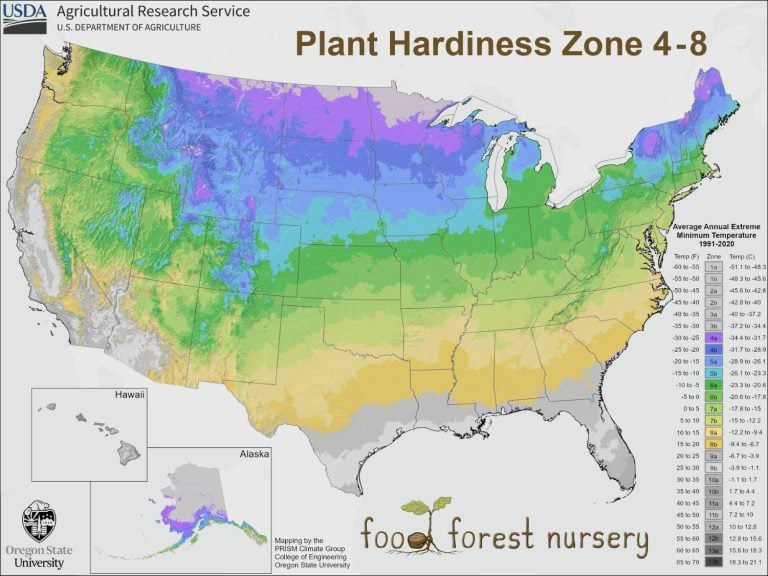
Brandywine Maple (Acer rubrum ‘Brandywine’) is a U.S. National Arboretum-bred red maple selected from an ‘October Glory’ × ‘Autumn Flame’ cross, growing 35 to 50 feet tall with brilliant scarlet to reddish-purple fall color that is notably more consistent than the species. It grows in USDA hardiness zones 4-9 and AHS heat zones 1-9.
Brandywine is a cultivar of Acer rubrum developed through a directed cross at the U.S. National Arboretum. The breeding cross — Acer rubrum ‘October Glory’ x Acer rubrum ‘Autumn Flame’ — was made in 1982 as part of a national arboretum research initiative targeting improved fall color consistency and predictability in red maple. The cultivar was subsequently released to commerce in 1995. Brandywine is a male clone, producing pollen in early spring but setting no seeds — a trait valued in landscape settings where the prolific winged samaras of female red maple selections create litter management challenges. Its underlying species, Acer rubrum, is one of the most broadly distributed native trees in eastern North America, ranging from Newfoundland south through Florida and west into Minnesota and eastern Texas. Princeton Nurseries of New Jersey, long associated with early red maple cultivar introductions, is cited in some catalog histories as a distributor, though the National Arboretum is consistently identified as the developer. No active patent has been identified.
Red maple's native range spans both seasonally flooded bottomlands and dry upland ridges, and Brandywine inherits that flexibility while performing best in consistently moist, moderately acidic soil in the pH range of 4.5 to 6.5. Highly alkaline soils trigger interveinal chlorosis as iron and manganese become unavailable to the roots, so growers on calcareous soils should acidify before planting rather than correcting after establishment. This cultivar tolerates periodic wet conditions better than many shade trees, making it a strong candidate for rain gardens and low-lying sites where drainage is imperfect. Drought tolerance is low to moderate, and trees planted in exposed positions or thin soils may scorch leaf margins during summer dry spells in humid climates. Mulching the root zone out to the drip line reduces moisture loss, moderates soil temperature, and prevents the mower damage to surface roots that is a primary entry point for canker pathogens. Spacing at 25 to 40 feet accommodates the mature canopy and prevents the surface root interference with hardscapes that occurs when trees are planted too close to pavement.
USDA Hardiness Zone: 4-9 AHS Heat Zone: 1-9 Sun Requirements: Full Sun to Partial Shade Soil pH: 4.5-6.5 Soil Type: Clay, loam, sandy loam; tolerates wet soils Soil Drainage: Well-drained to moist; tolerates periodic wet Water Requirements: Medium to High; prefers consistently moist soil Drought Tolerance: Low to Moderate Heat Tolerance: Moderate; best performance through Zone 9 with adequate moisture Plant Spacing: 25-40 ft apart Container Suitability: Not suitable; large canopy tree with aggressive surface root system
Brandywine develops an upright oval to rounded crown with a strong central leader, reaching 35 to 50 feet tall with a 25 to 40 foot spread at maturity. The moderate growth rate produces denser, stronger branch architecture than faster-growing Autumn Blaze or Silver Maple, reducing storm breakage risk. Leaves emerge with a reddish tint in spring, mature to medium to dark green above with a glaucous gray-green underside, then shift to scarlet or reddish-purple in autumn. The shallow, fibrous root system spreads laterally near the soil surface, aiding moisture uptake but creating tension with nearby pavement and lawn mowing equipment. Siting at least 10 to 15 feet from hardscape edges prevents root heaving that requires expensive remediation. The upright-oval form requires minimal structural pruning beyond removing crossing or co-dominant leaders in the first decade; the natural crown shape is itself a landscape asset, supporting a 100 to 150 year lifespan in well-chosen sites.
Mature Height: 35-50 ft tall Mature Spread: 25-40 ft wide Growth Habit: Upright oval to rounded; deciduous tree with strong central leader Growth Rate: Moderate Foliage Type: Deciduous Food Forest Layer: Canopy Leaf Color: Medium to dark green above; glaucous gray-green beneath Fall Foliage Color: Brilliant scarlet to reddish-purple; more consistent than species Thorns?: No Attracts Wildlife: Bees, butterflies, moths, songbirds, small mammals, squirrels Life Span: 100-150+ years
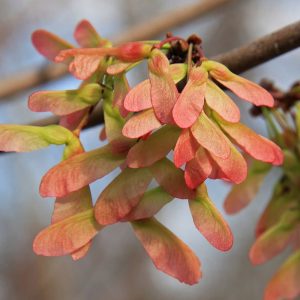
Brandywine is a male clone of Acer rubrum, producing exclusively pollen-bearing staminate flowers. No seeds are set, eliminating the samara litter that blankets lawns under female red maple cultivars. Small clustered red flowers open in late March to early April in temperate climates, appearing before leaf emergence and providing one of the season's earliest nectar pulses for bees active on warm late-winter days. Pollination is wind-driven, with insects serving as secondary vectors. Brandywine can function as a pollen donor for nearby female or monoecious red maple selections: October Glory Maple and similar cultivars in the vicinity will produce samaras when bloom windows overlap, which they typically do. Growers planting Brandywine for shade and ornamental display need no additional companions; the male-clone status removes seed-set management from the maintenance picture entirely.
Bloom Season: Late Bloom Window: Late Mar - Early Apr Pollination Requirements: Wind-pollinated; male clone produces pollen only, no seeds Pollination Mechanism: Wind Flower Color: Red
As a male clone, Brandywine sets no fruit or seeds, so this section covers the tree's foliage, sap, and wildlife contributions in place of a traditional fruit profile. The sap can be tapped in late winter like sugar maple, though red maple sap contains roughly half the sucrose concentration of Acer saccharum, requiring proportionally more boiling to produce syrup. The samaras are absent in this male clone, but the spring flowers produce nectar that supports early foraging bees and other pollinators. Summer foliage with glaucous undersides creates two-toned leaf movement in wind that adds textural interest to the canopy from late spring through early autumn. The fall foliage shift to scarlet or reddish-purple is the primary ornamental feature and occurs reliably across the tree's range, unlike the species type where color varies widely by individual seedling. Larval feeding by luna moth and other Lepidoptera species that use Acer rubrum as a host plant contributes to broader food-web support without significantly compromising tree health in established specimens.
Culinary Uses: Sap can be boiled into maple syrup (lower sugar content than sugar maple)
Soil-borne Verticillium Wilt (Verticillium dahliae / V. albo-atrum) is the most serious concern: this fungus persists indefinitely and has no curative treatment once vascular tissue is colonized; plant only in well-drained sites, protect the trunk from mowing wounds, and never replant a susceptible maple into a confirmed Verticillium site. Anthracnose (Aureobasidium apocryptum / Discula campestris) produces brown leaf lesions in cool, wet springs; raking and removing fallen leaves each autumn eliminates the primary overwintering inoculum. Nectria Canker (Neonectria galligena / Neonectria cinnabarina) enters through wounds and stressed bark — consistent irrigation and bark protection are the most effective preventive tools. Tar Spot (Rhytisma americanum) creates striking black foliar blotches but causes negligible damage; autumn leaf removal breaks the cycle. Bacterial Leaf Scorch (Xylella fastidiosa) spreads by leafhoppers and has no cure; mulching and irrigation to maintain tree vigor are the primary defenses. Potato Leafhopper (Empoasca fabae) poses little practical threat given this cultivar's good resistance. Cottony Maple Scale (Pulvinaria innumerabilis) and Maple Aphids (Drepanaphis spp. / Periphyllus spp.) are moderate concerns; OMRI-listed horticultural oil applied at crawler emergence in late spring is effective. Flatheaded Appletree Borer (Chrysobothris femorata) is moderately resisted; preventing bark wounds and transplant stress removes the primary egg-laying entry points.
Soil pH first: Test pH before planting and amend to the 4.5–6.5 range — alkaline soils cause persistent chlorosis that no foliar treatment can fully correct.
Verticillium site screening: Avoid planting where previous susceptible hosts (tomato, strawberry, potato, or prior maples) showed wilt symptoms; this pathogen persists in soil for years without a host.
Root zone protection: Maintain a 3–4 inch mulch ring extending to the drip line; this single practice reduces both mechanical trunk wounds (Nectria entry points) and moisture stress (Bacterial Leaf Scorch accelerant).
Scale monitoring: Check branch undersides in late May and early June for cottony white masses indicating Cottony Maple Scale crawlers; OMRI-listed horticultural oil applied at crawler emergence is most effective before the protective wax coat forms.
Male clone advantage: Brandywine produces no samaras, eliminating the lawn and gutter litter common with seeding female red maples — a landscape-design asset, not a deficiency.
We ship in late winter or early spring based on your USDA hardiness zone.
We strive to ship orders on the scheduled dates listed in the table below. However, please note that the actual shipping date may be subject to change due to factors like weather conditions and order volume.
The specific date for shipping your order will be determined according to your zipcode at the time of checkout.
Our plants are shipped bare root, packed in moist sawdust, and securely wrapped in plastic to prevent the roots from drying out. We use USPS Ground Advantage for shipping, ensuring that your plants typically arrive within 2-5 days after packaging.
In case you're unable to plant the trees immediately upon arrival, we recommend soaking them in water for a few hours and temporarily heeling them in. Ideally, they should be planted within three days of receipt for optimal health.
Our 365-Day Plant Guarantee: We ensure that our plants are delivered to you alive and healthy. If your plant does not survive its first year, you're eligible for store credit under these conditions:
You maintain the roots' moisture and plant within three days of delivery, following the instructions in our Planting Guide.
If you're concerned about your plant's health, please consult our guide, How to Tell if Your Tree is Dead or Dormant. Remember, our plants are shipped in a dormant state and may leaf out at different times based on their species. To check for plant vital
Reviews
There are no reviews yet.
Be the first to review “Brandywine Maple”Cancel Reply





Reviews
There are no reviews yet.