Blue Damson Plum
$49.95
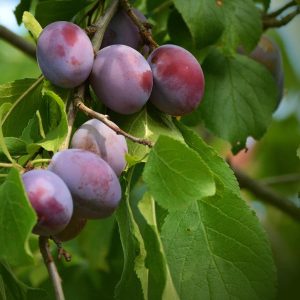
Blue Damson Plum (also known as Damascene Plum; Prunus domestica) is an ancient subspecies bearing small, tart, dark blue-purple freestone fruit with golden flesh — too astringent to eat fresh but unmatched for jams, damson gin, and preserves. It grows in USDA hardiness zones 5-8 and AHS heat zones 1-7, needs 700-900 chill hours, and is self-fertile, fruiting reliably without a pollinator partner.
4-5′ Bare Root Grafted Tree
Rootstock: Krymsk 1
A dwarfing plum and apricot rootstock at roughly half standard size, suited to close spacing and small yards, and tolerant of wet ground.
• Support: Stake for the first several years.
Can’t be shipped to: AK, CO, HI, MT, OR, WA
In stock
Damson plums trace their name and lineage to the ancient city of Damascus, the Latin prunum damascenum giving rise to Middle English damascene and eventually the modern word damson. Pliny the Elder documented small dark plums of this type in his first-century Natural History, and archaeological evidence from Roman-era camp sites in England confirms that damsons were carried across Europe as Roman legions established settlements. Prunus domestica subsp. insititia, the insititia subspecies, is genetically distinct from the larger domestica prune-types and likely predates them in cultivation. No modern breeding program is credited with Blue Damson; the variety represents a long-stabilized traditional landrace, selected over centuries within British orchard culture for deep blue skin, small oval fruit, and culinary intensity rather than fresh-eating appeal. It became a cornerstone of English country preserving traditions, prized for damson cheese, preserves, and gin-style spirits. Its commercial significance in Britain persists through the 21st century.
Blue Damson performs reliably across zones 4–8, needing around 800 chill hours — a standard mid-continent requirement met throughout most of the Eastern US and upper Midwest. Full sun is essential: shaded branches produce lighter crops and are more prone to fungal pressure, so choose an open site with at least six to eight hours of direct light daily. Well-drained loam or sandy loam at pH 5.5–6.5 is ideal. Heavy clay soils that hold moisture through humid summers elevate Cytospora canker risk at the trunk collar; raised planting or mounding by 6–8 inches significantly improves drainage. Consistent moderate irrigation during fruit set supports heavier crops; prefer drip or soaker methods over overhead irrigation to limit foliar wetness and fungal pressure. Space trees 12–20 feet apart to ensure adequate airflow. Mulch 3–4 inches deep out to the drip line, keeping mulch clear of the trunk, to maintain soil moisture and suppress weeds without inviting crown rot.
USDA Hardiness Zone: 5-8
AHS Heat Zone: 1-7
Chill Hours: 700-900
Sun Requirements: Full Sun
Soil pH: 5.5-6.5
Soil Type: Loam, sandy loam, clay loam
Soil Drainage: Well-drained
Water Requirements: Medium
Drought Tolerance: Moderate
Plant Spacing: 12-20 ft apart
Container Suitability: Not recommended for standard; semi-dwarf possible in large containers
Blue Damson develops an upright-spreading canopy reaching 15–20 feet tall and wide at maturity on standard rootstock, placing it in the low-canopy or understory layer in a food forest design. The branching architecture is moderately dense, which benefits from annual dormant pruning to maintain an open vase or central-leader structure that admits light and air to the interior — both important for managing the disease pressure this variety attracts. The root system is spreading and moderately deep fibrous, anchoring the tree well without aggressive suckering typical of some European plum stocks. Growth rate is moderate, with trees reaching productive size in 3–5 years from planting. Foliage is medium green and deciduous; fall color is minimal. White blossoms emerge mid-March to early April, arriving earlier than many fruit trees and making spring frost protection a relevant site consideration in zones 4–5. The tree is thornless, making harvest and pruning straightforward. Mature specimens can be productive for 40–60 years with attentive management.
Mature Height: 15-20 ft tall
Mature Spread: 15-20 ft wide
Growth Habit: Upright-Spreading
Growth Rate: Moderate
Foliage Type: Deciduous
Food Forest Layer: Canopy, Sub-canopy
Leaf Color: Medium green
Thorns?: No
Attracts Wildlife: Bees, Butterflies, Birds
Life Span: 40-60+ years
Blue Damson Plum flowers in the late relative window in the Zone 7 Ozarks planning model. Often sold as self-fertile, but Cornell's generic blue-damson treatment conflicts. For dependable set, pair with a compatible European plum blooming Mid-Late.
Bloom Season: Late
Bloom Window: Apr 5-Apr 20
Pollination Requirements: Self-fertile; Partly self-fruitful or disputed; use a compatible second cultivar for a dependable crop
Pollination Mechanism: Insect (bee)
Flower Color: White
Ploidy: Not cultivar-confirmed; damson/insititia material is reported as hexaploid, with cytotype variation in the group.
Fruit measures roughly 0.75–1 inch in diameter — noticeably smaller than most commercial plums — with dark blue-purple skin carrying a natural waxy bloom and golden-yellow flesh inside. The skin is semi-thick and adheres to the pit, and the flesh is semi-dry and somewhat dense rather than juicy. Flavor raw is sharply tart, astringent, and complex, with a spicy-sweet background note; cooked, the astringency mellows and the flavor deepens into rich, jammy intensity with a distinctive tannic complexity that sweeter plums cannot replicate. Culinary applications center on preservation: damson jam and jelly, traditional damson cheese (a firm, sliceable fruit paste), chutneys, and sauces. Blue Damson also forms the base of damson gin and similar infused spirits, where its high tannin and acid content balances the spirit beautifully. Baked goods — tarts, crumbles, and cobblers — benefit from its flavor concentration. Refrigerated storage life is 1–2 weeks, though fruit destined for preserving is typically processed shortly after harvest. The tree bears heavy annual crops once established, with harvest from late August through mid-September in temperate climates.
Ripening Season: Very Late
Harvest Window: Late Aug - Mid Sep
Fruit Size: 0.75-1 inch
Flavor: Tart, sour, spicy-sweet; astringent; rich when cooked
Fruit Color: Dark blue-purple skin; golden-yellow flesh
Fruit Texture: Semi-dry, somewhat fibrous and dense flesh
Fruit Skin: Smooth, semi-thick with waxy bloom
Bearing Habit: Annual bearer; heavy crops
Years to Bear: 3-5 years
Storage Life: 1-2 weeks refrigerated
Culinary Uses: Jams, jellies, preserves, damson cheese, chutneys, damson gin, baking, sauces
Black Knot (Apiosporina morbosa) is the most serious disease threat for Blue Damson; susceptibility requires consistent management. Prune out all galls during dormancy, cutting 4 inches below visible infection, and destroy removed tissue — never compost it. Disinfect pruning tools with 70% isopropyl alcohol between cuts. An open canopy through annual pruning reduces the humid microclimate where spores spread. Plum Pox Virus (Potyvirus — Sharka) has no cure; source certified virus-free nursery stock, control aphid vectors with reflective mulch and companion planting, and remove infected trees immediately. Cytospora Canker (Leucostoma cincta / L. persoonii) is a moderate susceptibility — minimize stress through consistent irrigation, avoid late-summer nitrogen, and prune during dry weather. Plum Curculio (Conotrachelus nenuphar), Oriental Fruit Moth (Grapholita molesta), and Peachtree Borer (Synanthedon exitiosa) all present susceptibility. Kaolin clay before petal fall and branch-jarring over tarps target curculio; spinosad (OMRI-listed) targets fruit moth larvae. Beneficial nematodes (Steinernema carpocapsae) around the trunk collar in late August are the primary organic control for peachtree borer. Brown Rot (Monilinia fructicola) and Bacterial Spot (Xanthomonas arboricola pv. pruni) show moderate resistance, reducing spray program demands. Spotted Wing Drosophila (Drosophila suzukii) is moderately susceptible; harvest promptly and use exclusion netting during ripening.
Black Knot: Susceptible
Brown Rot: Moderately Resistant
Bacterial Spot: Moderately Resistant
Plum Pox Virus: Susceptible
Cytospora Canker: Moderately Susceptible
Plum Curculio: Susceptible
Oriental Fruit Moth: Susceptible
Peachtree Borer: Susceptible
Spotted Wing Drosophila: Moderately Susceptible
- Black Knot vigilance: Inspect every branch during late winter dormancy; remove galls 4 inches below visible infection and burn or bag the cuttings — spores released in spring spread rapidly to new wood.
- Virus source control: Always purchase Blue Damson trees certified disease-free; Plum Pox Virus is transmitted by aphids and has no cure once established in a tree.
- Early harvest for preserving: Pick fruit when skin is fully deep blue-purple but before it softens on the tree — slightly underripe damsons have higher pectin, producing firmer, better-gelling preserves.
- Peachtree Borer defense: Apply beneficial nematodes (Steinernema carpocapsae) around the trunk base in late August and keep a 12-inch mulch-free zone at the trunk collar to expose larvae to predators and desiccation.
- Curculio timing: Begin kaolin clay applications at first pink and maintain coverage through June drop — Plum Curculio adults are most active in the 4–6 weeks immediately after petal fall.
We ship in late winter or early spring based on your USDA hardiness zone.
We strive to ship orders on the scheduled dates listed in the table below. However, please note that the actual shipping date may be subject to change due to factors like weather conditions and order volume.
The specific date for shipping your order will be determined according to your zipcode at the time of checkout.
Our plants are shipped bare root, packed in moist sawdust, and securely wrapped in plastic to prevent the roots from drying out. We use USPS Ground Advantage for shipping, ensuring that your plants typically arrive within 2-5 days after packaging.
In case you're unable to plant the trees immediately upon arrival, we recommend soaking them in water for a few hours and temporarily heeling them in. Ideally, they should be planted within three days of receipt for optimal health.
See our full shipping policy and map here
| Zone | Ship Date |
|---|---|
| 11 - 8b | March 1st, 2027 |
| 8a - 7b | March 8th, 2027 |
| 7a | March 15th, 2027 |
| 6b | March 22nd, 2027 |
| 6a | March 29th, 2027 |
| 5b - 5a | April 12th, 2027 |
| 4b - 4a | April 26th, 2027 |
| 3b - 1a | May 3rd, 2027 |
Our 365-Day Plant Guarantee: We ensure that our plants are delivered to you alive and healthy. If your plant does not survive its first year, you're eligible for store credit under these conditions:
- Your location falls within the appropriate USDA hardiness zone for the plant variety (refer to our hardiness zone map).
- You maintain the roots' moisture and plant within three days of delivery, following the instructions in our Planting Guide.
If you're concerned about your plant's health, please consult our guide, How to Tell if Your Tree is Dead or Dormant. Remember, our plants are shipped in a dormant state and may leaf out at different times based on their species. To check for plant vital
Related products

Elephant Heart Plum
Checking fit
Red Haven Peach
Checking fitRated 5.00 out of 5
Stanley Plum
Checking fit
Orient Pear
Checking fitRated 5.00 out of 5


Reviews
There are no reviews yet.