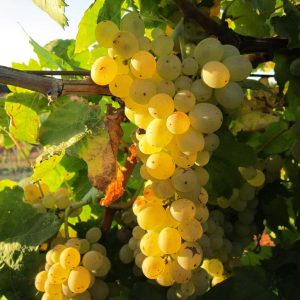
Venus Grape
$24.95
Venus Grape (Vitis hybrid) is a vigorous University of Arkansas seedless vine bearing aromatic blue-black berries with sweet muscat and labrusca notes, in medium-large clusters suited for fresh eating, juice, jelly, and wine. It grows in USDA hardiness zones 5-8 and AHS heat zones 3-9, needs 150-350 chill hours, and is self-fertile, fruiting reliably without a pollinator partner.
1-2′ Bare Root Vine
Propagation: Own-root
Can’t be shipped to: AK, HI, ID, OR, WA
Out of stock
Out of stock — back next season
Spring 2027 inventory drops in June. Drop your email and we'll notify you the day this variety is back in stock.
You're on the list. Check your inbox for a confirmation link — click it to lock in your spot. We'll email you the day this variety is back in stock.
Venus was the first grape cultivar released from the University of Arkansas breeding program, introduced in 1977 under the experimental designation Arkansas 1196. Developed by James N. Moore, who founded the program in 1964, Venus resulted from a cross of Alden — a seeded blue-black seedling with New York Geneva and vinifera parentage — with NY 46000, an interspecific hybrid carrying Vitis labrusca and Vitis vinifera genetics. Moore’s objective was a blue-black seedless table grape combining the slip-skin hardiness and disease adaptability of American species with berry quality attributes closer to European dessert varieties, specifically targeting the humid-summer growing regions of the South and mid-Atlantic. Venus delivered a distinctly aromatic, muscat-inflected flavor that its successor Arkansas releases — including Reliance, Mars, Saturn, and Neptune — did not replicate. Ripening in late July through early September, it was among the earliest-maturing seedless blue grapes available to eastern growers at the time of release, predating Reliance by five years. Venus established the proof of concept for the Arkansas planetary-name seedless grape series that would define the program’s commercial output over the following two decades.
Venus produces most reliably on a full-sun site with at least eight hours of direct light daily; shaded conditions reduce flower set and leave clusters more prone to fungal problems by slowing foliage drying after rain. Soil drainage matters more than fertility — roots sitting in standing water invite Phytophthora and Armillaria, so a gentle slope or raised bed often prevents the need for intervention later. Target a soil pH of 5.5 to 6.5; outside this range, nutrient lockout suppresses vigor even on otherwise healthy sites. Chill hour requirements of roughly 100 to 200 hours make Venus one of the least-demanding grapes for winter cold, fitting it for USDA zones 5 through 8 including warm transitional climates where other varieties fail to break dormancy cleanly. Consistent soil moisture during fruit set (typically late May through June) supports cluster fill; after veraison, drier conditions reduce berry splitting and Botrytis pressure. Established vines tolerate moderate dry spells without supplemental irrigation, but young plants need consistent watering through the first two growing seasons.
USDA Hardiness Zone: 5-8
AHS Heat Zone: 3-9
Chill Hours: 150-350
Sun Requirements: Full Sun
Soil pH: 5.5-6.5
Soil Type: Well-drained loam, sandy loam, or clay loam; tolerates a range if drainage is adequate
Soil Drainage: Well-drained; does not tolerate standing water
Water Requirements: Medium; consistent moisture during establishment, drought-tolerant once established
Drought Tolerance: Moderate; drought-tolerant once established
Plant Spacing: 6-8 ft between vines; 8-10 ft between rows on trellis
Container Suitability: Poor; vigorous vine requires large trellis or arbor, not suited to containers
How to Prune: Spur-prune heavily during winter dormancy; prune to 2-3 buds per spur to encourage fruiting wood and airflow; train on trellis or arbor
Venus is a vigorous climbing vine that routinely extends 10 to 20 feet in both height and spread when trained on a trellis or arbor, and it will reach the upper limit quickly on fertile, well-irrigated sites. That vigor is an asset on a large pergola or property-border planting but can overwhelm a small backyard structure if annual dormant pruning is deferred. The deep, wide-spreading fibrous root system anchors the vine against wind and contributes drought resilience once established, though it also means Venus should be sited at least six feet from garden beds where root competition would be disruptive. Foliage is medium green through the growing season, turning yellow to red-orange in autumn before leaf drop — a modest but genuine landscape feature. The absence of thorns makes training and harvest straightforward. Spur pruning to two to three buds per spur each winter keeps the fruiting canopy manageable and maintains the airflow that disease management depends on.
Mature Height: 10-20 ft tall
Mature Spread: 10-20 ft wide
Growth Habit: Vigorous climbing vine; semi-trailing; requires trellis, arbor, or fence support
Growth Rate: Fast; produces extensive new growth each season
Foliage Type: Deciduous
Food Forest Layer: Canopy, Vine
Leaf Color: Medium green
Fall Foliage Color: Yellow to red-orange
Thorns?: No
Attracts Wildlife: Birds, bees, butterflies, small mammals
Life Span: 20-50+ years with proper care
Venus carries perfect flowers — both male and female structures on the same blossom — and pollinates itself reliably without a second vine. Bloom falls in mid May through early June in a temperate climate, with wind and visiting insects both moving pollen effectively. While a dedicated pollinator is not required, placing a compatible interspecific hybrid nearby can increase cluster size and berry set; Mars Grape blooms in the same window and is a practical companion. Reliance Grape also overlaps in bloom timing and is widely planted alongside Venus in commercial and home-scale Eastern vineyards. Space vines six to eight feet apart within rows to encourage cross-pollination airflow without crowding canopies.
Bloom Season: Very Late
Bloom Window: Mid May - Early Jun
Pollination Requirements: Self-fertile; no pollinator required
Pollination Mechanism: Wind and insect (perfect flowers; self-fertile)
Flower Color: Pale green to yellowish-green; small and inconspicuous
Ploidy: Diploid (2n)
Clusters are medium to large, well-filled, and weigh roughly 250 grams (about half a pound) on average. Individual berries run 0.75 to 1 inch in diameter, placing them at the larger end of seedless American-hybrid types. The skin is thick and slip-type — the pulp separates cleanly from the skin — which some fresh-eating preferences consider a texture drawback compared to European varieties, but it contributes significantly to postharvest durability. Flavor is sweet and distinctly aromatic, carrying the muscat-floral character inherited from European parentage alongside the familiar foxy labrusca undertone. Sugar accumulation is moderate to high at peak ripeness, with Brix typically in the mid-teens under good conditions. Harvest runs late July through early September in a temperate climate, making Venus one of the earlier blue-black seedless options. Refrigerated clusters hold one to two weeks without significant quality loss. Beyond fresh eating, Venus works well for juice and jelly — the skin contributes deep color — and young leaves are edible and suitable for stuffed grape-leaf preparations.
Ripening Season: Early
Harvest Window: Late Jul - Early Sep
Fruit Size: 0.75-1 inch (medium-large berry; ~3 g per berry)
Fruit Weight: 3 g per berry; clusters average 250 g (0.5-0.6 lb)
Flavor: Sweet with muscat and labrusca (foxy) notes; aromatic; mild slip-skin texture
Fruit Color: Blue-black
Fruit Texture: Juicy, soft; slip-skin (pulp detaches from skin)
Fruit Skin: Thick, slip-skin; blue-black; slip-skin means pulp does not adhere to skin
Bearing Habit: Annual; bears on current season's canes arising from previous year's wood
Years to Bear: 2-3 years
Yield: 10-15 per plant in home garden
Storage Life: 1-2 weeks refrigerated; stores well post-harvest
Culinary Uses: Fresh eating, juice, jelly, jam, wine, raisins; young leaves for dolmas and cooking
Venus carries moderate susceptibility to several damaging fungal diseases in humid eastern climates, requiring consistent organic management. Black Rot (Guignardia bidwellii) is moderately susceptible; remove mummified clusters and infected canes during dormant pruning, as the fungus overwinters on this debris. Downy Mildew (Plasmopara viticola) and Powdery Mildew (Erysiphe necator) are both moderately susceptible; spur pruning and canopy leaf removal improve airflow and reduce leaf-wetness periods. OMRI-listed copper-based sprays at five- to seven-day intervals during wet weather reduce downy mildew pressure. Botrytis Bunch Rot (Botrytis cinerea) presents the highest susceptibility; thin dense clusters early and avoid overhead irrigation after bloom. Anthracnose (Elsinoe ampelina) is moderately susceptible; delayed-dormant lime-sulfur applications suppress overwintering spores. On the pest side, Spotted Lanternfly (Lycorma delicatula) is highly susceptible — scrape egg masses from bark in late winter and use circle traps during nymphal emergence. Grape Berry Moth (Paralobesia viteana) and Japanese Beetle (Popillia japonica) are both moderately susceptible; pheromone traps help time interventions. Grape Phylloxera (Daktulosphaira vitifoliae) shows moderate resistance — a meaningful advantage where own-rooted planting is practical.
Black Rot: Moderately Susceptible
Downy Mildew: Moderately Susceptible
Powdery Mildew: Moderately Susceptible
Botrytis Bunch Rot: Susceptible
Anthracnose: Moderately Susceptible
Grape Berry Moth: Moderately Susceptible
Japanese Beetle: Moderately Susceptible
Spotted Lanternfly: Susceptible
Grape Phylloxera: Moderately Resistant
- Spur-Prune Hard Every Winter: Venus's vigor means it will outgrow its structure rapidly if pruning is skipped. Cut back to two to three buds per spur on the established cordons; this keeps fruitwood close, improves airflow, and reduces fungal disease load the following season.
- Botrytis Prevention at Cluster Closure: When berry clusters compact and berries touch, remove a few interior berries per cluster with scissors to restore airflow. This step reduces Botrytis Bunch Rot losses consistently, especially in wet late-summer climates.
- Spotted Lanternfly Monitoring: In Mid-Atlantic and mid-South regions where Spotted Lanternfly is established, inspect trunks and canes for egg masses each February and scrape them into soapy water. Early removal is the most cost-effective intervention against a pest to which Venus is notably susceptible.
- Early Harvest Timing: Venus ripens earlier than most blue-black table grapes. Check clusters beginning in late July — sampling three to four berries from different cluster positions gives a reliable flavor read. Waiting too long increases Botrytis losses, especially in wet late-summer climates.
- Trellis Sizing at Planting: Install a trellis or arbor capable of handling 15 to 20 feet of lateral spread before planting. Retrofitting support around an established Venus vine is difficult and often results in structural damage during training.
We ship in late winter or early spring based on your USDA hardiness zone.
We strive to ship orders on the scheduled dates listed in the table below. However, please note that the actual shipping date may be subject to change due to factors like weather conditions and order volume.
The specific date for shipping your order will be determined according to your zipcode at the time of checkout.
Our plants are shipped bare root, packed in moist sawdust, and securely wrapped in plastic to prevent the roots from drying out. We use USPS Ground Advantage for shipping, ensuring that your plants typically arrive within 2-5 days after packaging.
In case you're unable to plant the trees immediately upon arrival, we recommend soaking them in water for a few hours and temporarily heeling them in. Ideally, they should be planted within three days of receipt for optimal health.
See our full shipping policy and map here
| Zone | Ship Date |
|---|---|
| 11 - 8b | March 1st, 2027 |
| 8a - 7b | March 8th, 2027 |
| 7a | March 15th, 2027 |
| 6b | March 22nd, 2027 |
| 6a | March 29th, 2027 |
| 5b - 5a | April 12th, 2027 |
| 4b - 4a | April 26th, 2027 |
| 3b - 1a | May 3rd, 2027 |
Our 365-Day Plant Guarantee: We ensure that our plants are delivered to you alive and healthy. If your plant does not survive its first year, you're eligible for store credit under these conditions:
- Your location falls within the appropriate USDA hardiness zone for the plant variety (refer to our hardiness zone map).
- You maintain the roots' moisture and plant within three days of delivery, following the instructions in our Planting Guide.
If you're concerned about your plant's health, please consult our guide, How to Tell if Your Tree is Dead or Dormant. Remember, our plants are shipped in a dormant state and may leaf out at different times based on their species. To check for plant vital
1 review for Venus Grape
Related products

Carlos Muscadine Grape
Checking fitRated 5.00 out of 5- SOLD OUT

Blanc du Bois Grape
Checking fit 
Niagara Grape
Checking fitRated 5.00 out of 5
Noble Muscadine Grape
Checking fitRated 5.00 out of 5

Jason Tibbetts (verified owner) –
Plant came dormant and moist. Well packaged. Little dirty, but I washed and cleaned it up. Roots are fresh and viable.