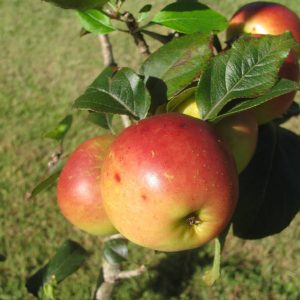
Ruby Tears Crabapple
$39.95
Ruby Tears Crabapple (Malus ‘Bailears’) is a weeping crabapple discovered as a chance seedling in Indiana, its pendulous cascading branches producing deep pink flowers from red-pink buds and tiny ruby-red fruit, offering four-season ornamental interest in tight spaces. It grows in USDA hardiness zones 4-7 and AHS heat zones 2-7, and needs about 600-1000 chill hours.
3-4′ Bare Root Grafted Tree
Rootstock: B118 – Semi Dwarf
A Budagovsky selection at roughly 85-90% of standard, so nearly full size. Exceptionally cold hardy and well anchored.
• Support: Freestanding; no staking required.
Can’t be shipped to: AK, HI
In stock
Ruby Tears was discovered as a chance seedling at Beverly Nursery in Indiana, subsequently selected and introduced by Bailey Nurseries of Newport, Minnesota under their First Editions plant program. The cultivar is patented under the registered name ‘Bailears’ (Plant Patent PP22,001). Observers have noted that its weeping form and foliage character resemble traits associated with ‘Louisa’ and ‘Prairiefire,’ suggesting these or related parentage, though no formal pedigree has been published. Bailey Nurseries developed the First Editions brand in the 1970s to commercialize superior seedling selections and new hybrids, and Ruby Tears represents its weeping crabapple entry — addressing a long-standing weakness in that form class, where many older weeping selections carried high scab susceptibility. The cultivar was selected with disease resistance as a primary criterion alongside the distinctively pendulous branching and burgundy-green summer foliage that the form class is valued for.
Ruby Tears performs across a wide range of soil types — clay, loam, and sandy soils all work, provided drainage is adequate. Wet feet during dormancy or extended standing water after rain events predispose the root system to Phytophthora-associated decline, so sites with natural slope or amended drainage are preferred over flat, compacted situations. Soil pH tolerance is generous at 5.5 to 7.0, covering most native mineral soils in humid eastern and midwestern regions without amendment. Full sun is required for both flowering density and disease suppression — shade encourages longer leaf wetness periods that favor fungal pathogens even in resistant cultivars. Once established over two to three seasons, the tree tolerates moderate drought, though summer dry spells during the first two years will slow root establishment and canopy development. Mulching a 3- to 4-foot radius around the base moderates soil temperature, retains moisture, and reduces weed competition without smothering the root collar.
USDA Hardiness Zone: 4-7
AHS Heat Zone: 2-7
Sun Requirements: Full Sun
Soil pH: 5.5-7.0
Soil Type: Adaptable; tolerates clay, loam, or sandy soils
Soil Drainage: Well-drained
Water Requirements: Medium; moderate moisture, established plants are drought tolerant
Drought Tolerance: Moderate; drought tolerant once established
The mature form is broadly weeping: branches arch outward and then cascade downward, producing a mounding silhouette that typically spreads 12 to 15 feet wide while reaching only 8 to 10 feet tall. This wider-than-tall proportion makes Ruby Tears distinctly suited to low-clearance situations — under power lines, along foundations, or as a focal specimen where upright trees would overshoot their space. Foliage emerges burgundy-red in spring and matures to a bronze-green or burgundy-green through the growing season, shifting to orange and red in fall before leaf drop. The fibrous, moderately shallow root system anchors well without the aggressive lateral spread associated with silver maple or cottonwood, making it compatible with hardscape proximity when given a reasonable buffer. Pruning is minimal by design: the cascading structure is self-organizing, and selective removal of any crossing or upward-growing branches in late winter is typically all the maintenance needed to preserve the intended weeping silhouette.
Mature Height: 8-10 ft tall
Mature Spread: 12-15 ft wide
Growth Habit: Weeping; pendulous cascading branches with broadly weeping form
Growth Rate: Moderate
Foliage Type: Deciduous
Food Forest Layer: Sub-canopy
Permaculture Role: Understory; pollinator attractor; wildlife food source
Leaf Color: Burgundy-red when emerging, maturing to burgundy-green
Fall Foliage Color: Orange and red
Thorns?: No
Attracts Wildlife: Birds, pollinators, butterflies
Life Span: 50-100+ years
Ruby Tears is self-sterile, meaning it will not set fruit without pollen from a genetically distinct compatible crabapple flowering within the same bloom window. Flowers open from deep red-pink buds to deep pink blossoms in early to mid-May, placing this cultivar in the mid-spring bloom category. Any diploid crabapple flowering during that same window serves as a functional cross-pollinator — bloom overlap of at least several days is sufficient for adequate insect-mediated pollen transfer. Good companion choices carried in this nursery include Prairie Fire Crabapple, which blooms slightly ahead of mid-May and provides a broad overlap, and Snowdrift Crabapple, whose mid-spring bloom window aligns well. Callaway Crabapple is another compatible option with documented mid-spring flowering. Bees are the primary pollination vector; siting the tree where ground-nesting and mason bees have access meaningfully increases fruit set.
Bloom Season: Very Late
Bloom Window: Mid May
Pollination Requirements: Self-sterile; cross-pollination required for fruit set
Pollination Mechanism: Insect-pollinated (bees)
Flower Color: Deep pink to pink; opens from deep red-pink buds
The fruit are small — roughly 3/8 inch in diameter — and ripen to dark ruby red by fall. Because Ruby Tears is selected primarily as an ornamental, fruit size and eating quality are secondary: the flesh is tart and astringent at fresh-eating stage, with the acid and tannin profile typical of small-fruited Malus hybrids. The main culinary application is jelly production, where high pectin content in small crabapples naturally firms the set without commercial pectin addition. Fruit persists on the branches well into winter — a characteristic that makes this cultivar genuinely valuable in the landscape. Cedar waxwings, American robins, and other frugivorous songbirds rely heavily on persistent crabapple fruit during late-winter food gaps when other food sources are scarce. The ornamental contribution of the deep red fruit clusters against bare weeping branches through January and February is one of the variety's most-cited landscape assets and distinguishes it from crabapples whose fruit drops or rots by December.
Fruit Size: 0.375 inch
Fruit Color: Dark red to ruby red
Bearing Habit: Annual bearing
Ruby Tears carries highly resistant ratings against the four most consequential fungal diseases in humid-summer climates: Apple Scab (Venturia inaequalis), Fire Blight (Erwinia amylovora), Cedar-Apple Rust (Gymnosporangium juniperi-virginianae), and Powdery Mildew (Podosphaera leucotricha). This profile eliminates the spray programs that susceptible crabapple cultivars require in wet springs — no copper fungicide applications for scab, no preventive fire blight programs, no rust-suppression schedule. Black Rot and Frogeye Leaf Spot (Physalospora obtusa) are moderately resistant; sanitation addresses this gap — removing mummified fruit and infected branches during winter pruning cuts inoculum load before the next season. On the pest side, Eastern Tent Caterpillar (Malacosoma americanum), Japanese Beetle (Popillia japonica), San Jose Scale (Quadraspidiotus perniciosus), and Woolly Apple Aphid (Eriosoma lanigerum) are all moderately susceptible and merit monitoring. Tent caterpillar egg masses overwinter on small branches and are easily spotted during dormant pruning. For Japanese beetle pressure, hand-picking in early morning when beetles are sluggish is most effective; place traps well away from the tree to avoid drawing additional beetles in. San Jose Scale is best managed with dormant oil before bud swell. Woolly aphid colonies can be knocked back with strong water sprays before populations build.
Apple Scab: Very Resistant
Fire Blight: Very Resistant
Cedar-Apple Rust: Very Resistant
Powdery Mildew: Very Resistant
Black Rot / Frogeye Leaf Spot: Moderately Resistant
Eastern Tent Caterpillar: Moderately Susceptible
Japanese Beetle: Moderately Susceptible
San Jose Scale: Moderately Susceptible
Woolly Apple Aphid: Moderately Susceptible
- Dormant oil for scale: Apply horticultural oil before bud swell to smother San Jose scale crawlers and overwintering egg masses — the most effective window for organic scale management.
- Prune to preserve weeping form: Remove upward-growing watersprouts or crossing branches in late winter only; summer pruning creates fire blight entry wounds during warm weather.
- Black rot sanitation: Remove and destroy all mummified fruit before spring to reduce black rot and frogeye leaf spot inoculum — the single highest-impact cultural step for this disease.
- Plant a mid-spring bloomer nearby: Cross-pollination from any compatible diploid crabapple flowering in early to mid-May maximizes fruit set and the ornamental winter fruit display Ruby Tears is known for.
- Deer browsing protection: Deer browse crabapple heavily; physical trunk guards and temporary fencing during the first two to three seasons protect the developing structure.
We ship in late winter or early spring based on your USDA hardiness zone.
We strive to ship orders on the scheduled dates listed in the table below. However, please note that the actual shipping date may be subject to change due to factors like weather conditions and order volume.
The specific date for shipping your order will be determined according to your zipcode at the time of checkout.
Our plants are shipped bare root, packed in moist sawdust, and securely wrapped in plastic to prevent the roots from drying out. We use USPS Ground Advantage for shipping, ensuring that your plants typically arrive within 2-5 days after packaging.
In case you're unable to plant the trees immediately upon arrival, we recommend soaking them in water for a few hours and temporarily heeling them in. Ideally, they should be planted within three days of receipt for optimal health.
See our full shipping policy and map here
| Zone | Ship Date |
|---|---|
| 11 - 8b | March 1st, 2027 |
| 8a - 7b | March 8th, 2027 |
| 7a | March 15th, 2027 |
| 6b | March 22nd, 2027 |
| 6a | March 29th, 2027 |
| 5b - 5a | April 12th, 2027 |
| 4b - 4a | April 26th, 2027 |
| 3b - 1a | May 3rd, 2027 |
Our 365-Day Plant Guarantee: We ensure that our plants are delivered to you alive and healthy. If your plant does not survive its first year, you're eligible for store credit under these conditions:
- Your location falls within the appropriate USDA hardiness zone for the plant variety (refer to our hardiness zone map).
- You maintain the roots' moisture and plant within three days of delivery, following the instructions in our Planting Guide.
If you're concerned about your plant's health, please consult our guide, How to Tell if Your Tree is Dead or Dormant. Remember, our plants are shipped in a dormant state and may leaf out at different times based on their species. To check for plant vital
Related products

Ein-Shemer Apple
Checking fitRated 5.00 out of 5
Granny Smith Apple
$49.95 Select Rootstock This product has multiple variants. The options may be chosen on the product pageChecking fit
Wolf River Apple
Checking fit
Honeygold Apple
Checking fitRated 5.00 out of 5


Reviews
There are no reviews yet.