Prelude Raspberry
$12.95
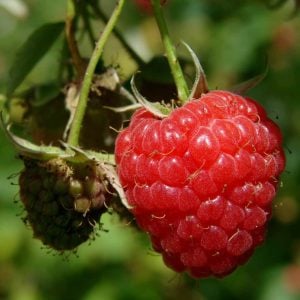
Prelude Raspberry (Rubus idaeus ‘Prelude’) is a dual-crop Cornell red raspberry with an early first harvest and a follow-up fall crop, bearing deep red, firm fruit with sweet, mildly tart flavor on self-supporting upright canes. It grows in USDA hardiness zones 4-8 and AHS heat zones 2-7, needs 800-1000 chill hours, and is self-fertile, fruiting reliably without a pollinator partner.
1-2′ Bare Root Plant
Propagation: Own-root
In stock
Prelude was developed by the small fruit breeding program at Cornell University’s New York State Agricultural Experiment Station in Geneva, New York and released in 1999, receiving U.S. Plant Patent PP11,747 (issued January 2001). The original cross was made in 1971; Prelude was the single selection chosen from a population of 141 seedlings. The documented parentage is NY 817 × Hilton, where NY 817 itself traces to Hilton × NY 60, and NY 60 descends from Durham × September — making Prelude a complex recombinant of several foundational northeastern red raspberry lines. The breeding objective was to push the summer floricane harvest significantly earlier than mid-season standards such as Latham, targeting commercial U-pick and fresh-market growers in colder climates who sought an earlier opening date. Prelude also bears a fall primocane crop, making it technically everbearing, though the summer floricane flush is its primary commercial feature. The patent has expired.
Prelude performs across a wide thermal band — zones 3 through 8 — and its 800-to-1,000-hour chilling requirement puts it squarely in mid-belt territory, satisfied easily from the Upper South northward through New England and the Great Lakes. Soil pH in the 6.0–6.5 range matters for nutrient uptake; drift above 6.5 suppresses iron and manganese availability, which shows up as interveinal chlorosis on new canes. The plant is intolerant of standing water. Raised-bed or ridged-row planting in heavy-clay soils helps maintain the drainage the crown demands — wet crowns accelerate Phytophthora pressure even on a resistant variety. Space plants 18 to 24 inches within the row and keep rows 8 feet apart to allow air circulation and equipment access. Consistent soil moisture during fruit set in late spring is critical; erratic irrigation during cell expansion leads to crumbly drupelets and reduced firmness. A 3-to-4-inch layer of wood-chip mulch conserves moisture, suppresses weeds, and keeps crown temperatures stable during temperature swings common in early spring.
USDA Hardiness Zone: 4-8
AHS Heat Zone: 2-7
Chill Hours: 800-1000
Sun Requirements: Full Sun to Partial Shade
Soil pH: 6.0-6.5
Soil Type: Sandy loam to loam, high organic matter
Soil Drainage: Well-drained; intolerant of wet soils
Water Requirements: Medium; consistent moisture during fruiting
Plant Spacing: 18-24 inches in row; 8 ft between rows
How to Prune: Remove fruiting floricanes immediately after summer harvest. In late winter, remove winter-damaged canes and thin remaining primocanes. For everbearing management, cut back fall-fruiting tips but leave the rest of the cane for summer production.
Prelude produces erect, upright canes reaching 4 to 6 feet with a spread of 4 to 5 feet as suckers colonize the row. Canes carry sparse spines — lighter than many older cultivars — which reduces handling injury during harvest and pruning. The root crown is perennial; individual canes follow the biennial cycle: primocanes develop in year one, overwinter, and fruit as floricanes the following summer before dying back. This architecture drives the pruning approach: floricanes should be removed promptly after summer harvest to reduce disease inoculum and redirect energy into developing primocanes. In late winter, remove winter-damaged canes and thin remaining primocanes to 4 to 6 per linear foot to balance airflow and yield. For the fall primocane crop, prune out only the fruited tips after harvest to allow the cane base to produce floricane fruit the following summer. Suckering habit forms a dense hedgerow over time; keep row width in check with a hoe or mower along the edges.
Mature Height: 4-6 ft tall
Mature Spread: 4-5 ft wide
Growth Habit: Erect, upright, suckering; biennial canes with perennial root crown
Foliage Type: Deciduous
Food Forest Layer: Shrub
Thorns?: Yes — sparse spines on canes
Attracts Wildlife: Bees, birds, butterflies, small mammals
Life Span: Perennial (roots/crown); individual canes biennial
Prelude is self-fertile — a single planting produces a full crop without a second variety. Bloom emerges mid-May through early June on floricanes, with white-to-pale-pink flowers structured to attract native bees, honeybees, and bumblebees, which are the primary agents transferring pollen. Wind moves some pollen, but insect activity drives fruit set rates in commercial trials. Planting near other primocane-fruiting varieties — such as Heritage Raspberry or Caroline Raspberry — extends the foraging window for pollinators and can modestly increase drupelet coherence through more thorough cross-pollination. Primocane flowers emerge in late summer on current-season growth, typically August through September, and follow the same insect-pollination pathway for the fall crop.
Bloom Season: Early
Bloom Window: Mid May - Early Jun
Pollination Requirements: Self-fertile
Pollination Mechanism: Insect-pollinated (bees); wind also contributes
Flower Color: White to pale pink
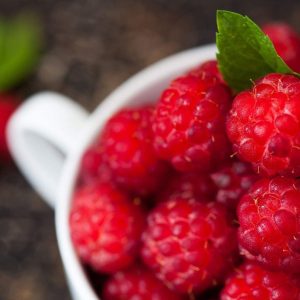
Berries are deep red, medium-sized at roughly 0.5 to 0.75 inch in diameter, with a firm and coherent drupelet structure that holds together better than many older red raspberry cultivars at the same stage of ripeness. Flavor is sweet with mild tartness — Cornell trial notes describe it as 'very good' for fresh eating, positioned between the sharper acidity of Latham and the richer sweetness of Heritage. High yield and firm texture make Prelude well-suited to U-pick operations and direct-market sales, where berry integrity during customer handling matters. The summer floricane crop in mid-June through early July tends to be the heavier of the two; the fall primocane crop (September through October) offers a lighter but welcome second harvest. Storage life runs 2 to 5 days refrigerated. Prelude freezes well, retaining color and structural integrity better than softer cultivars, which makes it a strong candidate for jam, jelly, baking, smoothies, and value-added processing.
Ripening Season: Very Early | Very Late
Harvest Window: Mid Jun - Early Jul | Mid Sep - Mid Oct
Fruit Size: 0.5-0.75 inch
Flavor: Sweet with mild tartness; very good flavor
Fruit Color: Deep red
Fruit Texture: Firm, coherent
Bearing Habit: Primocane-fruiting (everbearing): main floricane summer crop + secondary primocane fall crop
Years to Bear: 1-2 years
Storage Life: 2-5 days refrigerated; freezes well
Culinary Uses: Fresh eating, jam, jelly, baking, desserts, smoothies, freezing
Prelude is resistant to Phytophthora Root Rot (Phytophthora fragariae var. rubi), a destructive soilborne pathogen; drainage-first site preparation remains essential regardless. Spur Blight (Didymella applanata) resistance is also strong, limiting stem lesions that weaken canes before winter. Anthracnose (Elsinoe veneta) resistance is moderate; in humid climates, maintain row airflow through thinning and trellising, and remove infected canes at season's end. Gray Mold (Botrytis cinerea) and Cane Blight (Leptosphaeria coniothyrium) are moderate-susceptibility concerns. For Gray Mold, trellis canes to open the fruiting zone and harvest frequently — overripe fruit is primary inoculum. Cane Blight enters through pruning wounds; remove floricanes to ground level immediately after harvest using clean tools and clear all debris from the row. Spotted Wing Drosophila (Drosophila suzukii) warrants moderate vigilance: harvest every 1 to 2 days at peak flight and use fine-mesh exclusion netting. Raspberry Crown Borer (Pennisetia marginata) larvae overwinter in root crowns; a primocane wilting without drought stress is the diagnostic signal — remove and destroy infested crowns off-site. Japanese Beetle (Popillia japonica) is the most significant pest challenge. Hand-pick adults in the morning, deploy row covers during peak emergence, and apply OMRI-listed Kaolin clay or Spinosad as warranted.
Phytophthora Root Rot: Resistant
Gray Mold: Moderately Susceptible
Spur Blight: Resistant
Anthracnose: Moderately Resistant
Cane Blight: Moderately Susceptible
Spotted Wing Drosophila: Moderately Susceptible
Japanese Beetle: Susceptible
Raspberry Crown Borer: Moderately Susceptible
Raspberry Cane Borer: Moderately Susceptible
- Harvest the floricane crop early: Prelude's summer crop ripens ahead of most everbearing varieties — check canes daily starting mid-June in temperate climates to catch fruit at peak firmness before it softens.
- Remove floricanes immediately after harvest: Prompt removal cuts inoculum load for Cane Blight and Gray Mold. Remove to ground level and dispose of debris off-site, not in the compost pile.
- Trellis to open the fruiting zone: A T-bar or V-trellis with training wire at 3 and 5 feet significantly reduces Gray Mold pressure by improving airflow and reducing humidity in the canopy during fruit ripening.
- Manage Japanese Beetle early: Adults emerge in early summer and target fruiting canes; hand-pick in the morning or deploy row covers during peak emergence, typically 4–6 weeks. Avoid pheromone traps near the planting — they attract more beetles than they catch.
- Watch for Crown Borer wilting: A primocane wilting in midsummer without apparent drought stress is a Crown Borer signal. Dig the crown, remove and destroy infested root tissue, and do not compost.
We ship in late winter or early spring based on your USDA hardiness zone.
We strive to ship orders on the scheduled dates listed in the table below. However, please note that the actual shipping date may be subject to change due to factors like weather conditions and order volume.
The specific date for shipping your order will be determined according to your zipcode at the time of checkout.
Our plants are shipped bare root, packed in moist sawdust, and securely wrapped in plastic to prevent the roots from drying out. We use USPS Ground Advantage for shipping, ensuring that your plants typically arrive within 2-5 days after packaging.
In case you're unable to plant the trees immediately upon arrival, we recommend soaking them in water for a few hours and temporarily heeling them in. Ideally, they should be planted within three days of receipt for optimal health.
See our full shipping policy and map here
| Zone | Ship Date |
|---|---|
| 11 - 8b | March 1st, 2027 |
| 8a - 7b | March 8th, 2027 |
| 7a | March 15th, 2027 |
| 6b | March 22nd, 2027 |
| 6a | March 29th, 2027 |
| 5b - 5a | April 12th, 2027 |
| 4b - 4a | April 26th, 2027 |
| 3b - 1a | May 3rd, 2027 |
Our 365-Day Plant Guarantee: We ensure that our plants are delivered to you alive and healthy. If your plant does not survive its first year, you're eligible for store credit under these conditions:
- Your location falls within the appropriate USDA hardiness zone for the plant variety (refer to our hardiness zone map).
- You maintain the roots' moisture and plant within three days of delivery, following the instructions in our Planting Guide.
If you're concerned about your plant's health, please consult our guide, How to Tell if Your Tree is Dead or Dormant. Remember, our plants are shipped in a dormant state and may leaf out at different times based on their species. To check for plant vital
Related products

Heritage Raspberry
Checking fitRated 4.89 out of 5
Apache Blackberry
Checking fitRated 5.00 out of 5
Black Hawk Raspberry
Checking fit
Caroline Raspberry
Checking fitRated 4.71 out of 5


Reviews
There are no reviews yet.