Glacier Cherry
$59.95
Mid-season sweet cherry with ivory-cream skin, crack-resistant fruit, and broad cold-hardiness to Zone 5. Bred in the Pacific Northwest for reliable production across humid climates and the mountain West, and requires cross-pollination with a compatible variety such as White Gold Cherry or Stella Cherry to set fruit.
4-5′ Bare Root Grafted Tree
Rootstock: K5 – Semi Dwarf
Reduces tree size 20-30% against Mazzard. Precocious, compatible with all cherries, and adapted to both cold and hot climates on heavier soils. Plant certified virus-free stock — it is hypersensitive to ringspot and prune dwarf viruses.
• Support: Freestanding; well anchored with wide crotch angles.
In stock
Glacier is a Pacific Northwest sweet cherry (Prunus avium) selected for its combination of crack resistance, reliable production, and adaptability across a wider range of climates than most premium white-fleshed varieties. Developed through cherry improvement programs in the Pacific Northwest during the mid-twentieth century, Glacier was chosen as a commercial and home-orchard alternative to standard red sweet cherries, offering ivory to pale-cream skin at full ripeness alongside firm, sweet flesh. The variety gained traction particularly where summer rains during the harvest window cause chronic cracking losses in varieties such as Bing and Napoleon. Its Zone 5 cold-hardiness extends its range east into the Great Lakes and mid-Atlantic regions, and it has built a following among growers who want a white-fruited sweet cherry that tolerates variable weather without sacrificing flavor.
Glacier grows to a standard sweet cherry size of 18 to 25 feet on seedling rootstock, or 12 to 18 feet on semi-dwarfing stocks such as Colt or Gisela 6, with moderate annual vigor. It performs in USDA Zones 5 through 8, needs 700 to 900 chill hours, and tolerates winter lows into the negative teens Fahrenheit. Plant in full sun with at least 6 to 8 hours of direct light daily; sweet cherries on shaded sites produce small, poorly colored fruit and become more disease-prone. Well-drained loam or sandy loam with a soil pH of 6.0 to 7.0 suits it best. Standing water after rain events is a primary cause of root rot and canker entry points, so raised beds or sloped planting sites pay dividends on heavier soils. Glacier ripens mid-season, approximately 10 to 14 days after early-season varieties, which in Zone 7 temperate climates typically falls in late June to early July.
USDA Hardiness Zone: 5-8
Chill Hours: 700-1000
Sun Requirements: Full Sun
Soil pH: 6.0-7.0
Soil Type: Loam
Soil Drainage: Well-drained
Water Requirements: Medium
Glacier is a standard to semi-vigorous sweet cherry tree reaching 18 to 25 feet tall and 15 to 20 feet wide on seedling rootstock, with a broadly upright to spreading canopy typical of Prunus avium. Annual extension growth is moderate; trees on full-vigor rootstocks establish quickly and often begin bearing in the third or fourth year after planting. The bark is smooth gray-brown with the characteristic horizontal lenticels of the sweet cherry clan, and young growth is reddish-brown. Spring bloom is showy, with clusters of white five-petaled flowers emerging alongside unfolding leaves in mid-spring, slightly later than early-season varieties, which improves frost avoidance on frost-pocket sites. The foliage is medium green with a slightly glossy surface, turning copper-gold in autumn before leaf drop. Sweet cherries are not particularly drought-tolerant; consistent soil moisture during fruit development is necessary for both size and crack prevention even in crack-resistant varieties like Glacier. Trees live 25 to 40 years under good management.
Foliage Type: Deciduous
Permaculture Role: Pollinator support, wildlife food
Leaf Color: Green
Attracts Wildlife: Bees and butterflies (pollinators); birds and small mammals (fruit)
Glacier is self-unfruitful and requires a compatible Prunus avium pollinator blooming in the same mid-season window to set a commercial or home-garden crop. Because Glacier belongs to an S-allele incompatibility group that overlaps with some widely grown reds, pollinator selection matters. Lapins Cherry and Stella Cherry are the most reliable choices: both are self-fertile, bloom in the same mid-season window, and are documented as cross-compatible with Glacier across multiple university trial sites. Plant at least one pollinator within 50 feet for good bee transfer; two pollinators in a block further buffers against late-frost timing mismatches. Rainier Cherry also overlaps bloom timing and works as a third option where space allows. Standard sweet cherries rely on honeybees and native bees for pollination transfer; avoid applying any spray materials during open bloom.
Pollination Mechanism: Insect-pollinated (primarily bees)
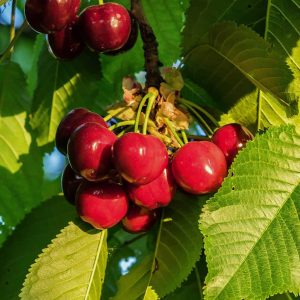
Glacier produces medium to medium-large sweet cherries with ivory to pale cream skin that may develop a light blush on sun-exposed shoulders at full ripeness. The flesh is cream-colored, firm, and sweet with a mild, clean flavor profile that leans toward honey-sweet rather than the more complex winey notes found in darker red varieties. Crack resistance is Glacier's signature attribute: the skin remains firm under rain exposure that splits Bing and similar thin-skinned varieties, making it especially valuable in humid summer climates and rain-prone harvest windows. Cherries ripen mid-season and hold on the tree for a week to ten days without significant quality loss when weather cooperates. The white-fleshed fruit resists staining during processing and is an asset for fresh eating, simple preserves, and cherry liqueurs where a lighter color is preferred. The mild sweetness and firm texture also make Glacier a good candidate for dehydrating into dried cherries with a golden rather than dark appearance.
Glacier carries moderate resistance to fruit cracking, its most commercially significant tolerance trait, but growers in humid climates should expect standard sweet cherry disease pressure from Brown Rot (Monilinia fructicola) and Cherry Leaf Spot (Blumeriella jaapii). Brown Rot can infect blossoms in wet springs and move into fruit near harvest; removing mummified fruit and maintaining open canopy airflow are the most effective cultural practices. Cherry Leaf Spot defoliates susceptible trees by late summer in the Eastern US if left unmanaged; Glacier shows no notable resistance to this pathogen and benefits from copper-based sprays or sulfur at first sign of infection. Bacterial Canker (Pseudomonas syringae) is a chronic risk on sweet cherries, favored by wet winters and spring pruning wounds; prune only during dry weather and seal large cuts to limit entry. Black Cherry Aphid (Myzus cerasi) colonies build quickly on new growth in early summer; knock back colonies with a strong water spray or introduce parasitic wasps before populations peak. Spotted Wing Drosophila (Drosophila suzukii) pressure intensifies on mid-season white-fleshed fruit because pale cherries are harder to monitor for early infestation; row covers or fine-mesh netting at harvest timing is the most effective barrier.
Cherry Leaf Spot: Moderately Resistant
Black Knot: Moderately Susceptible
X-Disease / Cherry Buckskin: Susceptible
Plum Curculio: Susceptible
Cherry Fruit Fly: Susceptible
Spotted Wing Drosophila: Susceptible
White-fleshed cherries like Glacier are harder to monitor for Spotted Wing Drosophila damage because larvae are nearly invisible against pale flesh; harvest promptly at full color change and refrigerate immediately rather than leaving fruit on the tree past peak ripeness. In humid climates, train Glacier to a taller open-center form with wide scaffold angles to maximize airflow through the canopy and reduce the damp micro-climate that favors Brown Rot and leaf spot.
We ship in late winter or early spring based on your USDA hardiness zone.
We strive to ship orders on the scheduled dates listed in the table below. However, please note that the actual shipping date may be subject to change due to factors like weather conditions and order volume.
The specific date for shipping your order will be determined according to your zipcode at the time of checkout.
Our plants are shipped bare root, packed in moist sawdust, and securely wrapped in plastic to prevent the roots from drying out. We use USPS Ground Advantage for shipping, ensuring that your plants typically arrive within 2-5 days after packaging.
In case you're unable to plant the trees immediately upon arrival, we recommend soaking them in water for a few hours and temporarily heeling them in. Ideally, they should be planted within three days of receipt for optimal health.
See our full shipping policy and map here
| Zone | Ship Date |
|---|---|
| 11 - 8b | March 1st, 2027 |
| 8a - 7b | March 8th, 2027 |
| 7a | March 15th, 2027 |
| 6b | March 22nd, 2027 |
| 6a | March 29th, 2027 |
| 5b - 5a | April 12th, 2027 |
| 4b - 4a | April 26th, 2027 |
| 3b - 1a | May 3rd, 2027 |
Our 365-Day Plant Guarantee: We ensure that our plants are delivered to you alive and healthy. If your plant does not survive its first year, you're eligible for store credit under these conditions:
- Your location falls within the appropriate USDA hardiness zone for the plant variety (refer to our hardiness zone map).
- You maintain the roots' moisture and plant within three days of delivery, following the instructions in our Planting Guide.
If you're concerned about your plant's health, please consult our guide, How to Tell if Your Tree is Dead or Dormant. Remember, our plants are shipped in a dormant state and may leaf out at different times based on their species. To check for plant vital
Related products

Lapins Cherry
Checking fitRated 5.00 out of 5
Kristin Cherry
Checking fit
Winesap Apple
Rated 5.00 out of 5$49.95 Select Rootstock This product has multiple variants. The options may be chosen on the product pageChecking fit
Royal Ann Cherry
Checking fit

Reviews
There are no reviews yet.