Black Locust
$11.95
Black Locust (also known as False Acacia; Robinia pseudoacacia) is a fast-growing nitrogen-fixing native hardwood producing fragrant white flower clusters edible as fritters or salads and providing one of the most important nectar sources for honeybees, on a spreading tree that stabilizes difficult, eroded sites. It grows in USDA hardiness zones 3-8 and AHS heat zones 1-8.
1-2′ Bare Root Seedling Tree
Propagation: Seedling (own-root)
In stock
Black Locust is the straight botanical species Robinia pseudoacacia, with no cultivar lineage or directed breeding — it is distinct from ornamental selections such as ‘Frisia’ (golden foliage) or ‘Purple Robe’ (flower color). Its native range is naturally disjunct: the primary population occupies the Appalachian Mountains from Pennsylvania south to Alabama and Georgia, with a smaller population centered on the Ozark and Ouachita highlands of Arkansas, Missouri, and Oklahoma. Seeds reached Europe in 1601 when botanist Jean Robin — royal herbalist to the French kings Henry III, Henry IV, and Louis XIII — planted them in his Paris garden; Carl Linnaeus later named the genus Robinia in Robin’s honor, and one of those original Paris trees still stands in the Square Rene Viviani. European introduction was followed by rapid naturalization across both hemispheres; by the early 18th century it was established across England, Hungary, and much of continental Europe. The species entered commercial horticulture as a seedling-grown native, and all plants offered under this name are wild-type genetic material.
Nitrogen fixation through root-nodule bacteria makes Black Locust genuinely self-sufficient on poor soils — it builds fertility rather than drawing it down, which is why it thrives on road cuts, mine spoils, and eroded hillsides where other trees fail. Soil pH tolerance spanning 4.6 to 8.2 means it adapts to nearly any site chemistry, though it requires good drainage; standing water triggers root rot and rapid decline. Once established, water needs are low to moderate — the tree is highly drought-tolerant and resents irrigated clay that stays wet. Full sun is essential for both healthy growth and maximum nitrogen-fixing activity; shaded specimens grow poorly and are far more vulnerable to locust borer attack. Spacing should account for aggressive root suckering: plant at least 20 feet from structures, pathways, and septic systems. Suckering intensifies dramatically after stem damage or cutting, so mowing around the base perpetuates colonies rather than controlling them. In states where Black Locust is classified as invasive outside its native range, check local regulations before planting.
USDA Hardiness Zone: 3-8
AHS Heat Zone: 1-8
Sun Requirements: Full Sun
Soil pH: 4.6-8.2
Soil Type: Clay, loam, sand; adaptable to a wide range of soil types including poor, rocky, and disturbed soils
Soil Drainage: Well-drained; does not tolerate wet or poorly drained soils
Water Requirements: Low to Medium; dry to medium moisture once established
Drought Tolerance: High
Heat Tolerance: High; tolerant of urban heat and difficult sites
Plant Spacing: 20-35 ft; minimum 20 ft from structures given aggressive root suckering
Container Suitability: Not Suitable; large suckering tree not appropriate for containers
At maturity, Black Locust reaches 30 to 50 feet tall with a spread of 20 to 35 feet, developing an upright trunk with a narrow irregular crown that becomes increasingly picturesque — and somewhat ragged — with age. Bark is deeply furrowed with interlacing ridges, gray-brown and corky, and the characteristic paired spines at each node (up to 1.25 inches long) make it easy to identify and require gloves during any pruning work. The root system is shallow and wide-spreading, generating root suckers prolifically, particularly after mechanical damage — a trait that makes it superb for erosion control on steep banks but problematic in maintained landscapes. Foliage is dark blue-green with an alternate pinnate structure; fall color is a muted yellow and not a landscape highlight. Growth rate during establishment is fast — 2 to 4 feet per year in youth — but slows substantially after age 30. The wood itself is extraordinarily dense and rot-resistant, with a service life in ground contact exceeding most commercially treated lumber.
Mature Height: 30-50 ft tall
Mature Spread: 20-35 ft wide
Growth Habit: Erect to oval; upright trunk with narrow crown becoming irregular with age; spreads by root suckers forming thickets
Growth Rate: Fast; 2-4 feet per year when young, slowing significantly after 30 years
Foliage Type: Deciduous
Food Forest Layer: Canopy
Permaculture Role: Nitrogen Fixer; Pioneer Species; Soil Reclamation; Biomass/Chop-and-Drop
Leaf Color: Dark blue-green
Fall Foliage Color: Yellow; unremarkable fall color
Thorns?: Yes; short paired spines up to 1.25 inches long at nodes
Attracts Wildlife: Bees, Butterflies, Hummingbirds, Songbirds, Squirrels, Game Birds; larval host for Silver-Spotted Skipper, Clouded Sulphur, and Zarucco Duskywing butterflies
Life Span: approximately 90 years; seed production continues until age 60
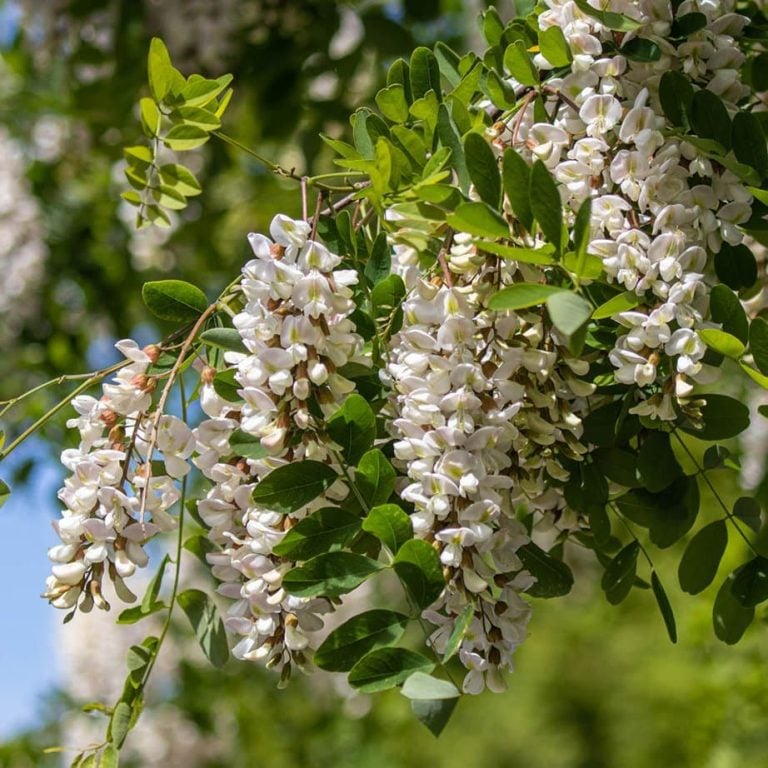
Black Locust is self-fertile and sets seed without a cross-pollinator, though bee visitation substantially increases seed set and pod fill. Flowers are pea-type, borne in pendant racemes of white blossoms from late April through early June in a temperate climate — a bloom window timed with peak honeybee foraging activity. The sweet, wisteria-like fragrance is powerful and carries some distance, making this one of the most important honey plants in the Eastern United States; locust honey is pale, mildly flavored, and resists crystallization. Flowers serve as larval host forage for Silver-Spotted Skipper, Clouded Sulphur, and Zarucco Duskywing butterflies. The floral structure requires bee visitation for full pollen transfer — the keel petals must be physically depressed by a landing insect to expose the reproductive parts, making wind pollination essentially ineffective for seed set even though the tree is nominally self-fertile.
Bloom Season: Mid
Bloom Window: Late Apr - Early Jun
Pollination Requirements: Self-fertile; also cross-pollinated by insects
Pollination Mechanism: Insect (primarily bees); pea-type flowers require bee or insect visitation for seed set
Flower Color: White
Black Locust bears flat, leathery seed pods 2 to 4 inches long that persist on the tree through winter, providing a seed source for game birds and squirrels. The pods contain 4 to 8 seeds each; raw seeds are toxic due to robinine alkaloids and should not be consumed by humans or livestock. Only the flowers are reliably edible — used in fritters, salads, and traditional European liqueurs — and they yield one of the most prized local honey types in the mid-Atlantic and Appalachian regions. The hardwood is the primary utilitarian product: with a specific gravity around 0.73 and standout natural durability, locust wood outlasts cedar and rivals black walnut for fence posts and structural applications. Biomass applications include high-calorie firewood and chop-and-drop mulch material. As a permaculture nitrogen source, leaves and small branches cut before seed set can be used as a high-nitrogen green mulch to accelerate decomposition in compost piles.
Culinary Uses: Edible flowers used in fritters, salads, and honey production; one of the most important honey plants for bees; flowers used to make locust flower fritters and wines in Europe
Black Locust faces two serious pest pressures that warrant active management. Locust borer (Megacyllene robiniae) is the most damaging threat: adult beetles lay eggs in bark crevices in late summer, and larvae bore into heartwood, weakening structural integrity and accelerating heart rot infection. Stressed trees — particularly those in full shade, compacted soil, or drought — are dramatically more susceptible. Maintaining vigorous tree health through appropriate siting in full sun with well-drained soil is the most effective cultural defense. Locust leafminer (Odontota dorsalis) produces extensive blotch mines on foliage, turning leaves brown by midsummer and giving an appearance of severe scorch. Repeated defoliation weakens trees but rarely kills established specimens; maintaining soil health and avoiding drought stress helps trees recover. Heart rot (Phellinus rimosus / Vanderbylia robiniophila) enters through borer wounds and bark damage; preventing mechanical injury and promptly removing severely compromised branches limits spread. Witches' broom (Chlorogenus robiniae) causes fasciated, broom-like branch clusters; prune and remove affected growth as soon as symptoms appear, cutting several inches below the visible abnormality and sanitizing tools between cuts. Thyronectria canker (Thyronectria austroamericana), powdery mildew (Microsphaera palczewskii), and leaf spot (Phleospora robiniae) are generally low-impact on well-sited trees and require no intervention beyond standard sanitation.
Heart Rot: Susceptible
Witches' Broom: Susceptible
Thyronectria Canker: Moderately Susceptible
Powdery Mildew: Moderately Susceptible
Leaf Spot: Moderately Susceptible
Locust Borer: Susceptible
Locust Leafminer: Susceptible
Locust Twig Borer: Moderately Susceptible
Black Locust Aphid: Moderately Susceptible
- Stress Reduction Prevents Borer Attack: Locust borer pressure rises sharply on stressed trees — prioritize full sun, well-drained soil, and avoiding root compaction. A healthy, fast-growing tree outpaces borer damage far better than any treatment.
- Manage Suckering Deliberately: Root suckers sprout vigorously after any root damage, including mowing. Cut suckers as close to the root as possible when still small; repeated cutting over 2–3 seasons is more effective than other approaches and aligns with organic management.
- Harvest Flowers Before Pods Form: For culinary use or honey production support, collect fresh flower racemes during the brief bloom window — flowers have a 7–10 day peak. Do not consume other plant parts — bark, leaves, pods, and raw seeds are toxic.
- Witches' Broom Pruning: Remove broom-affected branches with sanitized tools, cutting 6 inches below visible symptoms. Bag or burn removed material — do not compost it.
- Invasive Status Check: Black Locust is native in parts of the Appalachians and Ozarks but classified as invasive or noxious in several states. Confirm your state's regulations before planting, especially near natural areas.
We ship in late winter or early spring based on your USDA hardiness zone.
We strive to ship orders on the scheduled dates listed in the table below. However, please note that the actual shipping date may be subject to change due to factors like weather conditions and order volume.
The specific date for shipping your order will be determined according to your zipcode at the time of checkout.
Our plants are shipped bare root, packed in moist sawdust, and securely wrapped in plastic to prevent the roots from drying out. We use USPS Ground Advantage for shipping, ensuring that your plants typically arrive within 2-5 days after packaging.
In case you're unable to plant the trees immediately upon arrival, we recommend soaking them in water for a few hours and temporarily heeling them in. Ideally, they should be planted within three days of receipt for optimal health.
See our full shipping policy and map here
| Zone | Ship Date |
|---|---|
| 11 - 8b | March 1st, 2027 |
| 8a - 7b | March 8th, 2027 |
| 7a | March 15th, 2027 |
| 6b | March 22nd, 2027 |
| 6a | March 29th, 2027 |
| 5b - 5a | April 12th, 2027 |
| 4b - 4a | April 26th, 2027 |
| 3b - 1a | May 3rd, 2027 |
Our 365-Day Plant Guarantee: We ensure that our plants are delivered to you alive and healthy. If your plant does not survive its first year, you're eligible for store credit under these conditions:
- Your location falls within the appropriate USDA hardiness zone for the plant variety (refer to our hardiness zone map).
- You maintain the roots' moisture and plant within three days of delivery, following the instructions in our Planting Guide.
If you're concerned about your plant's health, please consult our guide, How to Tell if Your Tree is Dead or Dormant. Remember, our plants are shipped in a dormant state and may leaf out at different times based on their species. To check for plant vital
4 reviews for Black Locust
Related products

Smooth Sumac
Checking fitRated 5.00 out of 5
American Plum
Checking fitRated 4.63 out of 5
Pecan
Checking fitRated 4.33 out of 5
Aromatic Sumac
Checking fitRated 5.00 out of 5


Jane B. (verified owner) –
Thomas B. (verified owner) –
All the rootings were healthy.
Peter Nicolazzi (verified owner) –
Plants were healthy and strong
Anonymous (verified owner) –
its getting leaves